

If you have ever asked an SEO agency this question and got a vague non-answer, you are not alone. “It depends” is technically correct but completely useless if you are trying to decide whether to invest in SEO for your business right now.
So here is the honest answer: most businesses start seeing meaningful SEO results between three and six months. Some see movement earlier. Some take longer. And understanding why the timeline varies is far more useful than any single number an agency throws at you.
Here is what is actually happening during those months, and what determines whether you are on the faster or slower end of that window.
Why SEO Cannot Work Overnight
SEO is not a paid ad. You cannot put money in and get traffic out the next morning. The reason is that Google does not rank content based on how new it is or how much you spent. It ranks content based on trust, relevance, and evidence that real users found it useful.
Building that evidence takes time. Google needs to crawl your website, index your pages, observe how users interact with your content, and compare it against everything else ranking for the same keywords. That process happens across weeks and months, not hours.
Think of it this way. A new restaurant does not earn a reputation on its opening day. It earns it through consistent food quality, good service, and enough customers talking about it over time. SEO works the same way. You are building a reputation with Google, and that cannot be rushed.
What Actually Happens Month by Month
Understanding the phases of SEO helps set realistic expectations and stops you from panicking and quitting at month two when nothing looks like it is moving.
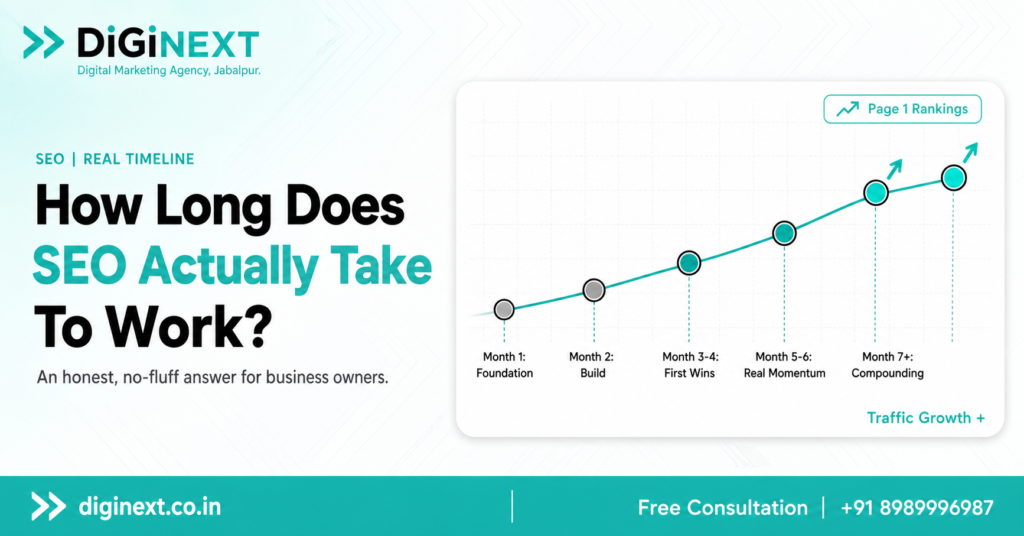
Months 1 to 3: Foundation Work
This is when the real groundwork happens. Technical issues get fixed, pages get properly optimised, content gets built or improved, and Google starts crawling the updated site more frequently. You may see small ranking movements for lower competition keywords. Traffic increase at this stage is usually minimal, but the work being done here is what determines how fast things move later.
Months 3 to 6: Early Momentum
This is where most businesses start to see visible movement. Rankings begin climbing for target keywords. Pages that were sitting on Page 3 or Page 4 start moving toward Page 2 and sometimes Page 1. Organic traffic begins to increase noticeably. This is also the phase where content quality becomes very obvious. Pages with genuine depth and useful answers to user queries move faster. Thin pages stay stuck.
Months 6 to 12: Compounding Results
By this point, consistent SEO work starts to compound. Pages that reached Page 1 begin holding their position and sometimes climbing further. New content builds on the authority already established. Organic traffic grows steadily without increasing ad spend. This is when the return on investment becomes very clear.
Factors That Make SEO Faster or Slower
Not every business starts from the same position, and that has a direct impact on the timeline.
Website age and history matter. A website that has been live for three years with some existing content will move faster than a brand new domain with no history. Google naturally takes longer to trust new websites.
Competition in your niche matters. If you are trying to rank for “SEO company in Jabalpur”, you are competing against a relatively defined set of local businesses. If you are trying to rank for “digital marketing,” you are competing globally against thousands of established websites. Local and niche keywords move faster.
Content quality matters more than most people realise. A website with ten well-written, deeply useful pages will outperform a website with fifty thin, vague pages every time. Google is specifically designed to reward content that answers user queries completely.
Technical health of your website matters. A slow, poorly structured website with crawl errors and broken links will hold back rankings regardless of how good the content is. Technical SEO fixes in the first month can have a measurable impact on how quickly the rest of the work pays off.
Consistency matters. SEO does not work if it is done for two months and then paused. Businesses that see the fastest results are the ones where work is ongoing. Google rewards websites that are consistently updated, improved, and growing.
The Mistake That Kills Most SEO Campaigns
The most common reason SEO fails to deliver results is not that it does not work. It is that businesses quit too early. Month two or three is the hardest point psychologically. Enough time has passed that patience wears thin, but not enough time has passed for rankings to visibly move. This is the exact point where most businesses either reduce investment or stop entirely.
The agencies that produce real SEO results are the ones that set honest expectations from day one and stay consistent through the slow early phase. If someone promises you Page 1 rankings in 30 days, walk away. That is either a lie or a short-term trick that will damage your website’s long-term credibility with Google.
Real Questions Business Owners Ask About SEO Timelines
1. Can SEO work faster than three months in some cases? Yes, in specific situations. If your website already has a solid technical foundation, some existing domain authority, and you are targeting low-competition local keywords, meaningful movement can happen within six to eight weeks. However, this is not the norm for most businesses starting SEO from scratch. Three to six months is the honest baseline to plan around.
2. What should I be seeing at the three-month mark to know it is working? At three months you should see Google crawling your site more frequently, some improvement in keyword positions even if not yet Page 1, and early traffic growth on lower-competition pages. Your SEO agency should be showing you ranking movement data, not just telling you things are progressing. If you have no data at three months, ask for it.
3. Does pausing SEO for a month or two set you back significantly? It depends on where you are in the process. If you have already built strong Page 1 rankings, a short pause may not cause immediate drops. But if you are still in the building phase, pausing creates gaps in momentum that extend your overall timeline. Competitors who stay consistent will continue gaining ground while you are paused.
4. Is SEO worth it for a small local business in Jabalpur? Absolutely. Local SEO for a specific city or region is significantly less competitive than national or global SEO. A well-executed local SEO strategy for a business in Jabalpur can produce Page 1 rankings within three to four months for the right keywords. The cost per lead from organic search, once rankings are established, is almost always lower than paid advertising.
5. How do I know if my current SEO agency is actually doing the work? Ask for monthly ranking reports showing movement across your target keywords, a log of changes made to your website each month, and content published or updated. A legitimate SEO agency will have clear, measurable activity to show you every single month. Vague updates and generic reports are a red flag.
What This Means for Your Business Decision
If you are sitting on the fence about whether to start SEO, the most important thing to understand is this: the best time to start was six months ago. The second best time is now. Every month you delay is a month your competitors are building rankings that will take you longer to catch up with.
SEO is not a quick fix. It is a long-term asset that, once built, continues delivering results without paying for every click. The businesses that dominate search results in their city did not get there overnight. They got there by starting, staying consistent, and giving it the time it actually needs.
If you are looking for honest, results-driven SEO services in Jabalpur, reach out to DigiNext at 8989996987 and get a clear plan built around your actual business goals and realistic timelines.