

Introduction
Here is something most business owners never check. Open your Instagram profile, then your website, then your Google Business Profile, then your business card. Now ask yourself honestly: does it all look and feel like it came from the same business?
For most local businesses in Jabalpur, the answer is no. The logo is slightly different on each platform. The colours do not quite match. The tone on Instagram is casual and friendly, while the website reads like a formal corporate brochure. The tagline on the business card says something completely different from the website headline.
This is a brand consistency problem, and it is silently undermining customer trust every single day. Not in a dramatic, obvious way. In the quiet, invisible way where a customer sees your business in three different places, gets three slightly different impressions, and walks away uncertain rather than confident. Uncertainty kills conversions. Confidence drives them.
Here is what is actually going wrong and what fixing it looks like in practice.
What Brand Consistency Actually Means (and What It Does Not)
Brand consistency does not mean every post looks identical or every piece of content follows a rigid template. That is uniformity, and it produces boring, forgettable content.
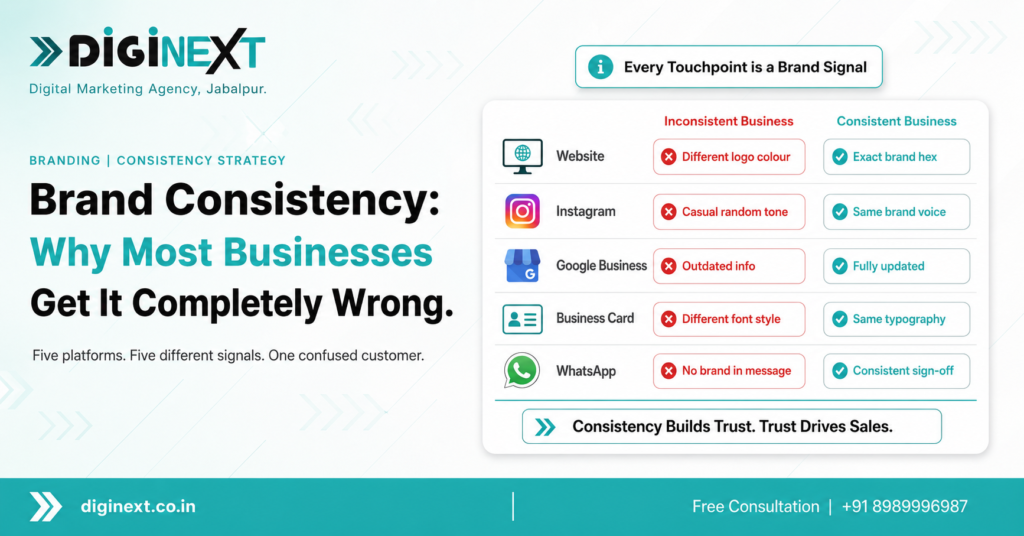
What it actually means is that every customer-facing touchpoint, whether it is your website, your social media profile, your invoice, your storefront, or your WhatsApp message, reflects the same identity. The same colours, the same logo treatment, the same tone, the same core message. The details adapt to the platform. The identity never changes.
Think about it this way. A person can dress formally for a client meeting and casually for a weekend outing. Their personality, values, and the way they carry themselves remain the same in both situations. That is consistency. A business that sounds authoritative and professional on its website but completely casual and unserious on Instagram, or that uses a different logo colour on Instagram stories versus its website header, is not adapting to context. It is sending confused signals about who it actually is.
Customers read those confused signals as a lack of professionalism, even when they cannot articulate exactly why the business feels slightly off.
The Five Places Where Inconsistency Kills Your Brand
Most businesses have inconsistency in at least three of these five areas. Check each one honestly.
Your visual identity across platforms. Does your logo look exactly the same on your website, your Instagram profile picture, your Facebook page, your Google Business Profile, your business card, and your WhatsApp Business account? Not similar. Exactly the same, in the same proportions, with the same colours using the exact hex codes. A logo that looks slightly stretched on Instagram, slightly too dark on the business card, and slightly different in colour on the website is three different signals presenting themselves as one brand.
Your tone of voice across content. Does your website sound like the same business that writes your Instagram captions? If your website uses formal, structured language and your Instagram uses slang and casual phrasing with no connection to the website messaging, you have two different voices. Customers who find you on Instagram and then visit your website to learn more encounter a disconnect that raises a subconscious doubt about which version is real.
Your core message across touchpoints. What is the single clearest thing you want every customer to know about your business? If that message is not present in some form on every platform, you are missing opportunities to reinforce the one thing that should make customers choose you. The business that communicates “fastest furniture delivery in Jabalpur” on every platform builds that association over time. The business that says it on the website, forgets it on Instagram, and uses a completely different positioning on Google Business Profile builds nothing.
Your visual content style. The photographs, graphics, and design elements you use across platforms should feel like they belong to the same brand family. A business using professional photography on its website but blurry phone camera photos on Instagram is sending inconsistent quality signals. A business using a clean, minimal design aesthetic on its website but busy, colourful, text-heavy graphics on social media is visually incoherent.
Your customer experience language. This one is the most overlooked. How your team answers the phone, how you respond to WhatsApp messages, how you handle enquiries by email, how you follow up after a purchase. All of these are brand touchpoints, and all of them should reflect the same values and tone as everything else the customer has seen.
Why Inconsistency is More Damaging Than No Brand at All
Here is the thing most business owners do not consider. A business with no branding effort is simply invisible. A business with inconsistent branding actively confuses customers.
Confusion triggers doubt. Doubt triggers inaction. A customer who encounters inconsistency across your touchpoints does not consciously think “this business is inconsistent.” They just feel vaguely uncertain about the business without knowing exactly why. They move on to a competitor who gives them a clear, consistent signal because clear signals feel trustworthy and trustworthy is what customers are looking for before they spend money.
Research on brand perception consistently shows that consistent brand presentation across all platforms increases revenue by up to 23 percent. The mechanism is straightforward: consistency builds recognition, recognition builds familiarity, familiarity builds trust, and trust converts into purchases. Every inconsistency in the chain breaks the process before it reaches the end.
What a Consistent Brand System Looks Like in Practice
Fixing inconsistency does not require a brand agency and a six-month project. For most small businesses in Jabalpur it requires three clear documents and the discipline to use them.
A brand style guide. A single document that specifies the exact logo files to use on different backgrounds, the exact hex codes for all brand colours, the exact fonts with sizes and weights, and the rules for how these elements appear together. This does not need to be a fifty-page document. A two-page reference sheet that answers the most common questions about visual application is enough to eliminate most visual inconsistency.
A voice and messaging guide. A document that defines the tone in plain, usable terms. Not “we are professional and friendly,” which means nothing. Specific guidance like “we use simple language, we never use jargon, we speak directly to the customer’s problem in the first sentence, and we avoid corporate phrases like ‘quality service’ and ‘customer satisfaction’.” “Include two or three example phrases that are on-brand and two or three that are off-brand.
A content template library. A set of ready-made templates for the most common content types: social media posts, stories, quote cards, promotional graphics, invoice design, and email signatures. When every template is built from the same visual foundation, the content produced from those templates will be consistent by default without anyone having to think about it.
With these three things in place, any team member creating content or any external agency working on your brand has what they need to stay consistent without constant supervision.
Real Questions Business Owners Ask About Brand Consistency
1. Does brand consistency matter if I am a solo business owner running everything myself?
It matters more, not less. As a solo operator, you are the brand. Every piece of content you create, every message you send, every interaction you have represents the business entirely. Without documented guidelines, even you will drift into inconsistency over time because different moods, different reference materials, and different time pressures produce different outputs. A simple brand reference document takes two hours to create and saves hundreds of hours of inconsistent output over the following years.
2. My business has grown and different team members are creating content. How do I bring consistency back?
Start with a brand audit. Collect examples of everything produced in the last three months: social media posts, graphics, emails, photos, customer communications. Lay them out and look for the patterns of inconsistency. Then create a simple style guide that addresses the specific inconsistencies you identified. Share it with everyone involved in creating content, run a short briefing session on how to use it, and review output against it monthly for the first three months until the standards become habitual.
3. Should my brand be consistent across platforms that have different audiences?
The core identity should be consistent. The format and content style can adapt to the platform. A LinkedIn post for a professional audience is longer and more analytical than an Instagram reel for a consumer audience. But both should use the same logo, the same colours, the same core message, and the same brand personality. The medium changes. The brand does not.
4. How often should I update my brand guidelines?
Update them when something substantive changes: a new logo, a refined colour palette, a shift in positioning or target audience. Minor content trends do not warrant a brand guideline update. A brand identity should be stable for at least three to five years. Updating it every year because design trends have shifted is the same mistake as inconsistency, just on a longer timeline. Customers need enough exposure to a consistent identity before they build recognition. Change it too often and you restart the recognition-building process from zero each time.
5. Is it worth hiring a professional to build a brand consistency system for a small local business?
For most small businesses in Jabalpur, the answer is yes if the business has more than one person creating content or is present on more than two customer-facing platforms. The cost of inconsistency in lost trust and lost customers almost always exceeds the cost of having a professional build a clear brand system. The system only needs to be built once and maintained with minor updates over time, which means the return on the investment compounds over years.
Consistency is the Work That Makes Everything Else Work Better
Here is the bottom line. Every other marketing investment you make, SEO, social media, Google Ads, content creation, works better when the brand behind it is consistent. Customers who encounter your brand multiple times across different platforms and get the same clear, professional signal accumulate trust faster. Customers who get a different signal each time never fully commit to trusting the business.
Brand consistency is not the most exciting part of building a business. It does not feel creative or dynamic. But it is the foundation that makes every creative and dynamic effort more effective. Without it, you are pouring marketing budget into a leaking system where every rupee spent produces less return than it should.