

Introduction
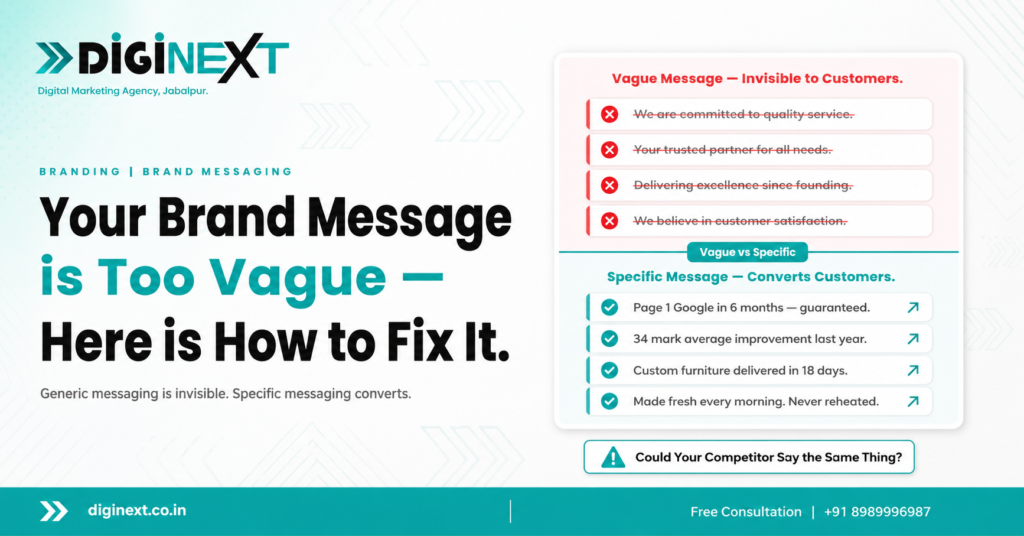
Read the homepage of almost any local business website in Jabalpur and you will find the same message dressed in slightly different words. “We are committed to quality and customer satisfaction.” “Your trusted partner for all your needs.” “Delivering excellence since our founding.” “We believe in putting customers first.”
These sentences communicate nothing. Not because the businesses do not mean them, but because every single business in every single category says exactly the same thing. A brand message that sounds like it could belong to any business in your category belongs to none of them. It is invisible to customers who are scanning options and looking for a specific reason to choose one business over another.
The damage is silent. Vague messaging does not repel customers dramatically. It simply fails to attract them. They read it, feel nothing, remember nothing, and move on to a business that told them something specific and meaningful. Here is why this happens and exactly how to fix it.
Why Vague Brand Messages Feel Safe But Perform Badly
There is a psychological reason most businesses settle for vague messaging. Specific messages can be challenged. If you say you deliver furniture in 18 days, a customer can hold you to that. If you say you are the most affordable coaching centre in Jabalpur, a competitor can undercut you. If you say your food is made fresh every morning, you have to actually do that every morning.
Vague messages feel safe because they make no commitments that can be tested or challenged. “We are committed to quality” is impossible to disprove. It is also impossible to remember, impossible to repeat to a friend, and impossible to use as a reason to choose you over a competitor who says exactly the same thing.
The irony is that specificity feels riskier but performs dramatically better. A specific brand message makes a claim that can be verified, which means customers can trust it. A vague message makes no claim at all, which means customers have no reason to trust anything. The business that is willing to say something specific and stand behind it consistently wins customers over the one that says everything vaguely and stands behind nothing.
The Four Signs Your Brand Message is Too Vague
Before fixing the message, it helps to diagnose exactly how vague it currently is. Here are four clear signs.
Sign 1: Your message could belong to any competitor in your category. Take your current tagline or homepage headline and replace your business name with a competitor’s name. Does it still make complete sense? If yes, your message is not specific enough to differentiate you. A message that works for everyone works for no one.
Sign 2: It describes what you do but not why it matters to the customer. “We provide digital marketing services” is a description. “We help local businesses in Jabalpur appear on Page 1 of Google within six months” is a benefit with specificity. The first tells the customer what you sell. The second tells the customer what they get. Customers buy results, not services.
Sign 3: It contains words like “quality,” “excellence,” “trusted,” or “customer satisfaction” without evidence. These words have been used so often in marketing that they have lost all meaning. They function as signals of vagueness rather than credibility. The moment one of these words appears without specific evidence attached to it, the customer’s brain filters it out.
Sign 4: You cannot say it in one sentence that a twelve-year-old would understand. A brand message that requires explanation is not a brand message. It is a paragraph. A strong message is simple enough that a child understands it and specific enough that an adult believes it.
What a Specific Brand Message Actually Looks Like
The structure of a specific brand message that converts has three components: who you serve, what specific outcome you deliver, and what makes you the right choice specifically.
Here is how that looks in practice for different business types in Jabalpur.
Vague version: “We are a digital marketing company committed to helping businesses grow online.”
Specific version: “We help small businesses in Jabalpur rank on Page 1 of Google within six months. If we do not, we work for free until they do.”
Vague version: “We provide quality coaching for students preparing for competitive exams.”
Specific version: “Our Class 12 students improved their board scores by an average of 34 marks last year. We take batches of maximum 15 students so every student gets individual attention.”
Vague version: “We are a trusted furniture manufacturer serving Jabalpur for many years.”
Specific version: “We make custom wooden furniture in Jabalpur and deliver within 18 days. Every piece is made to your exact measurements and comes with a three-year warranty.”
Vague version: “We offer affordable and delicious food with excellent service.”
Specific version: “Every dish at our restaurant is made fresh that morning from ingredients sourced locally. We do not refrigerate or reheat anything, ever.”
Notice the pattern in every specific version. There is a number, a specific proof point, a specific commitment, or a specific claim that separates it from every generic competitor in the same category. These messages are memorable because they say something real. They are trusted because they are specific enough to be verified. And they convert because they give the customer a specific reason to choose this business over all the others saying nothing in particular.
How to Write Your Specific Brand Message Right Now
The process of finding your specific message is not creative. It is investigative. You are looking for the real, specific thing that makes your business different in a way that actually matters to your customer. Here is a process that works.
Start by asking your best current customers two questions. First: “Why did you choose us instead of the other options you considered?” Second: “What is the one thing we do that you would miss most if we were not around?” The answers almost always reveal a specific differentiator that the business has never made explicit in its messaging.
Then take the most common answer and make it as specific as possible with numbers, timeframes, or verifiable proof. If customers say they chose you because you were faster, find out exactly how much faster and make that a specific claim. If they say the quality is better, find the specific quality element they noticed and document it as a specific commitment.
Then test the message by applying this filter: could a competitor in my category say exactly the same thing? If yes, make it more specific until the answer is no. When you have a message that is genuinely unique to your business and backed by something real, you have your brand message.
Real Questions Business Owners Ask About Brand Messaging
1. How often should I change my brand message?
A strong brand message should be stable for at least three to five years. Changing it frequently means customers never build the association between your business and the specific promise you make. The message should evolve when your business genuinely changes: new service offerings, new target audience, new competitive position. It should not change because you are bored of it or because a new trend emerged. The businesses with the most powerful brand messages are the ones that have been saying the same specific thing consistently for years.
2. Should my brand message be the same everywhere or can it adapt for different platforms?
The core promise should be identical everywhere. The format and length can adapt. A website homepage can expand the message with evidence and context. An Instagram post distils it to one memorable line. A Google Ad reduces it to a headline and one benefit. A WhatsApp message to existing customers can reference it briefly. The underlying claim, the specific thing that differentiates you, never changes regardless of where it appears.
3. What if I genuinely do not know what makes my business different?
This is more common than most business owners admit. Start by listing everything your business does that the average competitor in your category does not. Then rank those by how much they matter to your customers. If you genuinely cannot identify a single meaningful differentiator, that is a business positioning problem before it is a messaging problem. You may need to create a differentiator by making a specific commitment your competitors have not, before you can communicate it as a message.
4. My business serves multiple customer types. Can I have more than one brand message?
You can have one primary brand message and secondary messages tailored to specific audience segments. But the primary message should be clear and singular enough to be memorable. A business with five different messages for five different audiences has no clear identity in any customer’s mind. Start with the audience that represents your highest-value customers and build the primary message around what matters most to them. Secondary messages for other segments are supporting layers, not alternatives.
5. How do I know if my new specific brand message is actually working?
Measure three things over three months. First, whether more customers mention your specific differentiator when they enquire, which means the message is reaching and resonating with the right people. Second, whether your conversion rate from enquiry to sale improves, which means the message is building more confidence before the first conversation. Third, whether referrals increase, which means existing customers can now articulate why they recommend you in a specific way. All three together tell you whether the message is doing its job.
Specific Wins. Generic Loses. Every Single Time.
The most important principle in brand messaging is one that most business owners understand intellectually but fail to apply consistently: customers do not respond to claims of quality. They respond to specific proof of a quality that matters to them, communicated clearly enough to remember and specific enough to believe.
A brand message that is vague is not a neutral choice. It is an active failure to give customers the specific reason they need to choose you. Every day your messaging stays generic is a day the competitor with the more specific message wins the customer who should have been yours.
Fixing your message is not about being more creative or more persuasive. It is about being more honest and more specific about the real, verifiable thing that makes your business worth choosing. Find that thing, state it clearly, back it up consistently, and say it everywhere.