

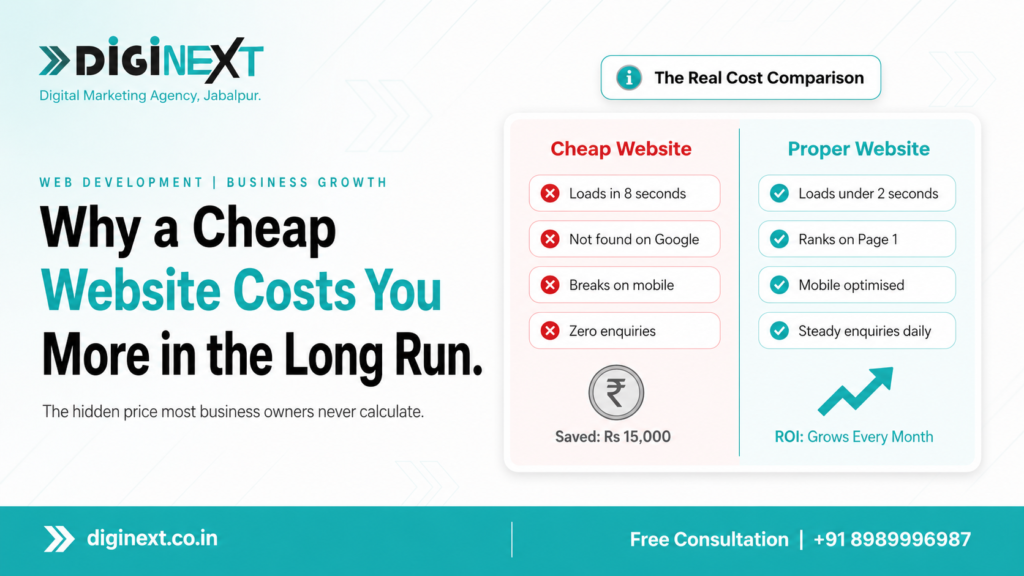
A website for five thousand rupees sounds like a great deal. You get an online presence, something to put on your business card, and a place to send people when they ask if you have a website. What is not to like?
Here is the problem. A cheap website is not a small version of a good website. It is a fundamentally different product that looks similar on the surface but fails at the one job a business website actually needs to do: convert visitors into customers. And the cost of that failure, measured in lost enquiries, lost rankings, and the eventual expense of rebuilding it properly, almost always far exceeds whatever was saved upfront.
This is the full picture that most web designers offering rock-bottom prices never show you.
A Cheap Website Does Not Build Trust – It Destroys It
The first thing a potential customer does when they hear about your business is search for you online. What they find in those first few seconds determines whether they call you or move on.
A website that looks outdated, loads slowly, has broken layouts on mobile, or uses generic stock images and template text tells the visitor one thing immediately: this business does not take itself seriously enough to invest in its own presentation. If a business cannot be bothered to present itself properly online, why would a customer trust it with their money or their project?
This is the hidden cost most business owners never calculate. It is not the money spent on the cheap website. It is the money lost from every visitor who landed on it, made a quick judgement about the quality of the business based on what they saw, and left to contact a competitor with a more credible online presence.
Trust is built or broken in seconds online. A cheap website consistently breaks it.
Cheap Websites Are Almost Never Built for SEO
A website that cannot be found on Google is not a business asset. It is an expensive business card that only people who already know you will ever see.
Most budget websites are built purely for visual presentation with zero consideration for how search engines read and rank them. The pages have no proper keyword structure, the meta titles and descriptions are either missing or auto-generated from page titles, the images have no alt text, the page loading speed is poor, and the site structure makes it difficult for Google’s crawlers to understand what the business does and who it serves.
The result is a website that sits invisibly on Page 4 or Page 5 of Google for any relevant search or does not appear at all. A business in Jabalpur that paid five thousand rupees for a website and gets zero organic traffic from it has not saved money. It has paid for something that delivers no return and will continue to deliver no return until it is rebuilt properly.
When that business eventually comes to a professional agency and asks why their website is not ranking, the answer is almost always the same: the foundation was wrong from the beginning, and patching it is often harder and more expensive than starting fresh.
The Hidden Ongoing Costs Nobody Mentions
The upfront price of a cheap website is only the beginning. The real costs come later and they compound.
Security vulnerabilities. Cheap websites are often built on outdated themes and plugins with known security holes. A hacked website that starts distributing malware or redirecting visitors to spam pages will get blacklisted by Google. Recovering from a Google blacklist is a lengthy, complicated process that can take months and requires significant technical work.
No mobile optimisation. A website built cheaply in 2020 or 2021 may render acceptably on desktop but break completely on the mobile screens your customers are actually using. Fixing responsive design issues on a poorly built site often requires rebuilding entire sections or starting over.
Constant maintenance failures. Cheap websites are typically handed over with no ongoing support agreement. When something breaks, and something always eventually breaks, the business owner either pays per-incident rates to fix it or lives with a broken website for months.
Rebuilding costs. This is the biggest hidden cost of all. Most businesses that buy a cheap website end up rebuilding it within two to three years. By that point they have paid for the cheap website, lost revenue from its poor performance, and now need to pay for a proper website anyway. The total cost is significantly higher than if they had done it properly the first time.
What a Properly Built Website Actually Does for Your Business
A well-built website is not just a prettier version of a cheap one. It is a fundamentally different business tool.
It loads fast enough on mobile that visitors stay instead of leaving. It is structured in a way that Google can read, rank, and recommend. Every page is built around a specific customer intent, with content that answers their questions and a clear path to contact you. The design builds credibility from the first second, so the trust that drives enquiries is established before the visitor has even scrolled.
A properly built website works as a 24-hour salesperson. It finds customers through search, answers their questions, builds their trust, and drives them to call or enquire. A cheap website sits there passively and hopes someone who already knows the business will visit it.
The difference in business outcomes between these two things is not marginal. For local businesses in Jabalpur competing in any reasonably active category, a well-built website that ranks and converts can be the single biggest source of new customer enquiries every month.
Real Questions Business Owners Ask About Website Investment
1. How much should a small business actually spend on a website?
There is no universal number, but as a realistic guide for a local business in Jabalpur, a properly built website with SEO-ready structure, mobile optimisation, fast loading, and professional design typically starts from fifteen thousand to thirty thousand rupees depending on the number of pages and complexity. Ongoing maintenance and SEO work is separate. Anything significantly below this range usually involves compromises in one or more of the critical areas: speed, structure, SEO readiness, or design quality.
2. Can a cheap website be improved rather than rebuilt?
Sometimes, but it depends on how it was built. If the underlying code is clean and the platform is solid, improvements like speed optimisation, SEO setup, and design updates can be made without a full rebuild. But if the site was built on a heavily customised page builder with bloated code, an outdated theme, or a platform that does not support proper SEO configuration, patching it is often more expensive in time and money than rebuilding on a proper foundation.
3. What should I specifically look for when choosing a web development agency?
Ask to see examples of websites they have built and check those sites on PageSpeed Insights yourself. Ask them how they handle on-page SEO setup during the build. Ask whether the site will be mobile-first. Ask what platform it will be built on and why. Ask what happens when something breaks after handover. A professional agency will have clear, confident answers to all of these. Vague answers or pressure to decide quickly are warning signs.
4. Is a website still necessary if my business is active on social media?
Yes, and for a specific reason. Social media platforms own your audience. If Instagram or Facebook changes its algorithm, restricts your account, or simply declines in usage among your customers, your entire online presence disappears overnight. A website is owned property. Your domain, your content, and your Google rankings belong to your business regardless of what happens to any social platform. Social media and a website serve different but complementary roles. One without the other is an incomplete strategy.
5. How long does a properly built website last before it needs to be updated or rebuilt?
A well-built website on a maintained platform with regular updates should serve a business effectively for four to six years with periodic content updates and design refreshes. The key is ongoing maintenance: keeping the platform and plugins updated, refreshing content regularly, and monitoring performance. A neglected website, even a well-built one, will degrade over time. Budget for ongoing care, not just the initial build.
The Real Question is Not How Much Your Website Costs
The right question is not what the website costs to build. It is what it costs your business every month it fails to perform. A website that loses you three enquiries per month because of poor design, slow loading, and zero Google visibility is costing you far more than the difference between a cheap build and a proper one. That cost is just invisible, which is why it is so easy to ignore.
The businesses in Jabalpur that consistently grow their customer base through digital channels are not the ones who spent the least on their website. They are the ones who treated their website as a serious business investment and built it accordingly.
If you are ready to build a website that actually brings in customers, or if you want an honest assessment of why your current website is not performing, reach out to DigiNext at 8989996987 and get a clear picture of what your website should be doing for your business.