
Introduction
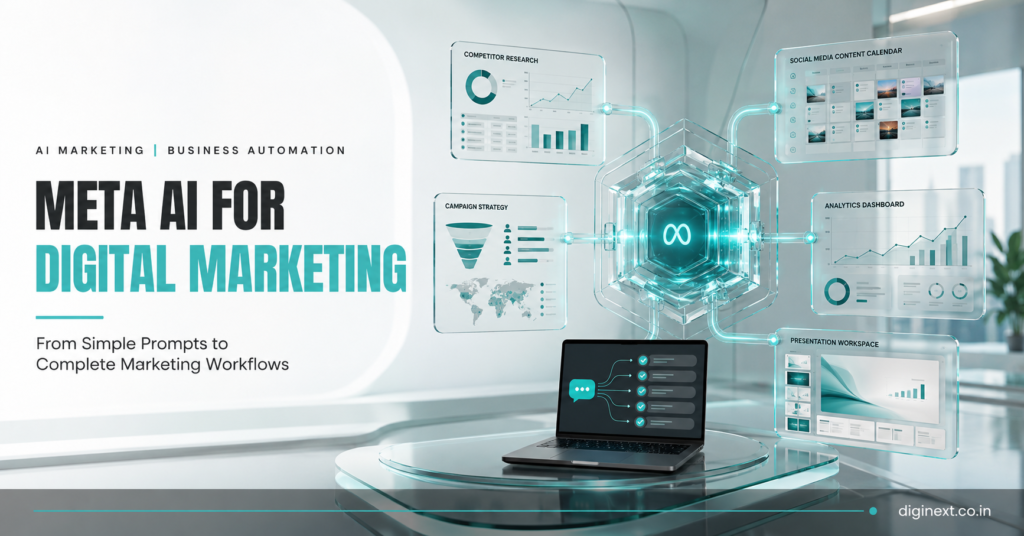
Meta AI for digital marketing is becoming far more significant than another content-generation tool. Meta has upgraded its assistant so that it can plan tasks, conduct detailed research, connect with selected applications, create presentations and continue recurring assignments with less manual prompting.
This represents a major shift. Earlier AI assistants primarily responded to individual questions. The emerging generation of AI agents can understand an objective, divide it into multiple steps and perform actions on the user’s behalf.
For businesses, this could reduce the time required for research, planning and routine marketing operations. However, faster execution does not automatically produce better marketing. Strategy, local knowledge, brand positioning and human verification remain essential.
What Is New in Meta AI?
Meta says its upgraded assistant, powered by Muse Spark 1.1, can create plans, follow through on tasks and work with connected email and calendar applications. It can also produce slides, conduct research and provide recurring updates based on instructions established by the user.
For example, a user could ask Meta AI to research a particular market, organise the findings and create a presentation. Instead of requiring a separate prompt for every stage, the assistant can manage a larger portion of the workflow.
Meta also states that its research feature can build research plans, search across multiple sources and prepare structured reports with citations. These capabilities move Meta AI closer to an action-oriented assistant than a traditional chatbot. Meta’s official announcement and Meta AI product information provide further details.
How Is an AI Agent Different from a Chatbot?
A chatbot generally completes one request at a time. You ask a question, receive an answer and provide another prompt if you want the process to continue.
An AI agent works towards a broader objective. It can plan the required steps, use connected tools, gather information and complete several related actions.
Consider a small business preparing a festive marketing campaign.
A conventional chatbot might generate ten social media captions. An AI agent could potentially research competitors, identify content opportunities, prepare a posting schedule, organise campaign ideas and create a presentation for review.
The practical difference is not merely better writing. It is workflow execution.
Five Ways Small Businesses Could Use Meta AI
1. Conducting market and competitor research
Businesses can use Meta AI to explore competitors, customer interests, industry developments and emerging content themes.
This can provide a useful starting point for campaign planning. However, the findings must be checked against actual competitor activity, keyword data and local customer behaviour. AI-generated research should support decision-making, not replace evidence.
2. Planning social media content
Meta AI can help organise weekly or monthly content calendars around products, customer problems, festivals and promotional campaigns.
A local business could ask it to develop separate ideas for Instagram, Facebook and WhatsApp. The plan can then be refined according to platform behaviour, brand tone and audience preferences.
The common mistake will be publishing the plan without customisation. If several businesses use similar instructions, their content may sound and look nearly identical.
3. Creating campaign presentations
Preparing a campaign proposal often involves collecting data, structuring recommendations and designing slides. Meta AI’s presentation capabilities could reduce the time spent creating the initial version.
Marketing teams may use it to prepare internal briefs, content plans, competitor comparisons and campaign summaries. Human review is still required to correct claims, improve visual hierarchy and ensure that the recommendations match the client’s budget.
4. Producing recurring reports and updates
The assistant can reportedly manage recurring tasks, such as preparing regular briefings or tracking topics of interest.
For marketers, this could support weekly trend reports, campaign reminders and summaries of relevant industry developments. It may help teams identify changes faster, but it cannot independently determine whether every trend deserves a response.
Businesses do not need to participate in every trend. They need to select the trends that reinforce their positioning.
5. Supporting customer and campaign planning
Meta AI can help organise customer questions, develop campaign themes and suggest content for different stages of the buying journey.
For example, a car-detailing business might need educational posts for awareness, service comparisons for consideration and limited-time offers for conversion. AI can accelerate the first draft of this structure.
The final campaign still requires accurate pricing, real customer objections, appropriate targeting and consistent follow-up.
Where Businesses Can Go Wrong
The biggest risk is assuming that automation is the same as strategy.
AI may produce a convincing report containing weak assumptions, outdated information or incorrect details. If a business connects an AI agent with email, calendars or other tools, permission management and data privacy also become important.
Businesses should watch for five common problems:
- Publishing unverified statistics or claims
- Producing generic content that resembles competitors
- Sharing confidential customer or business information
- Automating actions without clear approval controls
- Measuring output volume instead of business results
An AI system can create fifty posts quickly. That does not mean those posts will attract qualified enquiries.
Will Meta AI Replace Digital Marketing Agencies?
Meta AI is more likely to change agency work than eliminate it.
Routine research, first drafts, reporting and basic planning will become faster. The value of an agency will increasingly depend on its ability to understand the market, identify the right message, verify information and convert ideas into measurable campaigns.
A capable digital marketing agency should provide what a general AI tool cannot deliver independently:
- Local market understanding
- Customer and competitor insights
- Brand-specific creative direction
- Campaign targeting and budget decisions
- Performance analysis and continuous improvement
This is particularly important for businesses seeking a reliable digital marketing company in Jabalpur. Local competition, customer language, geographic targeting and offline buying behaviour cannot be handled effectively through generic automation alone.
What Should Businesses Do Now?
Businesses should begin with small, controlled applications rather than automating their entire marketing process.
Select one repetitive task, such as content research or weekly trend reporting. Compare the time saved against the quality of the final result. Establish a review process before allowing AI-generated material to reach customers.
The strongest approach combines three elements:
AI for speed, people for judgement and data for decisions.
Companies that treat AI as a shortcut for publishing more content will add to the existing noise. Companies that use it to research faster, test ideas and improve execution will gain a meaningful advantage.
Final Takeaway
Meta AI’s agentic upgrade signals the next stage of AI-assisted marketing. The focus is moving from generating isolated pieces of content to managing complete workflows.
This can help small businesses reduce repetitive work and respond more quickly. It does not remove the need for positioning, creative judgement or marketing strategy.
DigiNext helps businesses combine AI-enabled efficiency with local market understanding, professional content and performance-focused campaigns. If you want to improve your digital marketing without turning your brand into generic automated content, connect with DigiNext for a practical growth strategy.
Frequently Asked Questions
1. What is Meta AI for digital marketing?
Meta AI can assist marketers with research, content planning, presentations, recurring updates and other multi-step tasks. Its usefulness depends on how well the output is reviewed and adapted.
2. Can Meta AI create a complete marketing campaign?
It can help prepare campaign ideas and supporting material. Human input is required for positioning, budgets, targeting, verification and final approval.
3. Is Meta AI suitable for small businesses?
Yes. Small businesses can use it to reduce time spent on research and planning. They should begin with low-risk tasks and maintain a clear review process.
4. Can AI agents replace social media managers?
They can automate parts of the workflow, but they cannot fully replace brand judgement, audience understanding, creative direction and customer communication.