
Introduction
Here is a problem most business owners do not talk about because it is uncomfortable to admit. The marketing is working. Enquiries are coming in. The phone is ringing, the WhatsApp messages are arriving, and the contact form is getting submissions. And yet the revenue is not matching the enquiry volume. Somewhere between “I am interested” and “I will take it”, a significant portion of potential customers are disappearing.
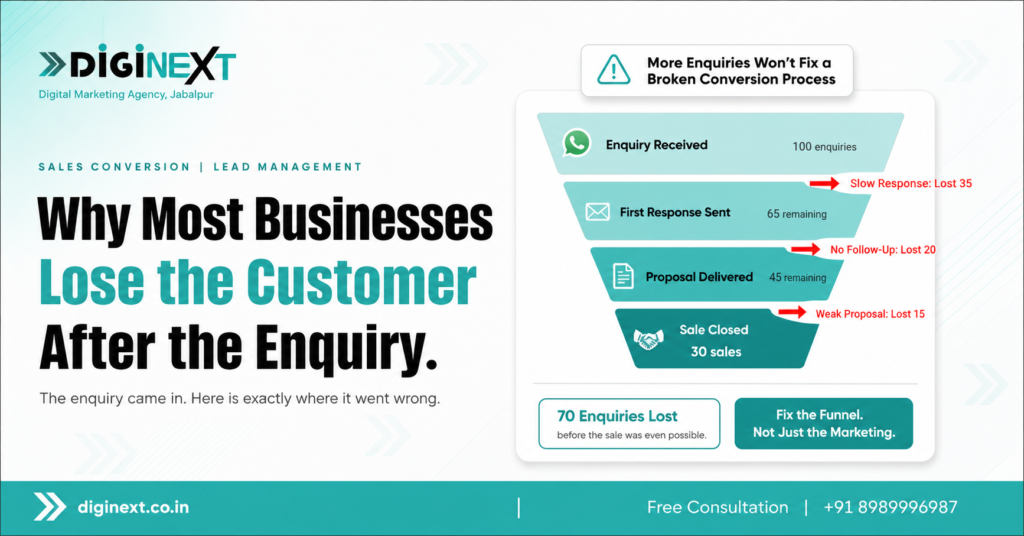
Losing customers between enquiry and sale is one of the most expensive and most ignored problems in local business. Most owners respond to a revenue shortfall by spending more on marketing to generate more enquiries. But if the conversion process is broken, more enquiries just means more money spent acquiring customers who still do not buy. The leak is in the pipeline, not in the top of the funnel.
Here is exactly where customers are being lost and what needs to change at each stage.
The Slow Response That Hands the Customer to a Competitor
Speed is the single most impactful variable in converting enquiries into sales for local businesses in Jabalpur. Not price, not quality, not reputation. Speed of initial response.
Research on lead response time consistently shows that the likelihood of converting an enquiry drops by more than 80 percent if the first response takes longer than five minutes. That sounds extreme until you think about what is happening on the customer’s side. A customer who sends a WhatsApp message or fills in a contact form is evaluating multiple options simultaneously. The business that responds first, clearly and professionally, wins a disproportionate share of the conversation. The business that responds six hours later finds the customer has already spoken to two or three competitors and made a mental shortlist that does not include them.
Most small businesses in Jabalpur respond to enquiries when it is convenient for the owner. Between meetings, after lunch, at the end of the day. That schedule works perfectly for the business and terribly for conversion. A customer who enquired at 11am and heard nothing until 4pm has already made a decision by then. Whether or not they explicitly told anyone, they have moved on mentally.
The fix is not complicated but it requires a clear commitment. Every enquiry gets an acknowledgement within fifteen minutes during business hours, even if the full response comes later. A WhatsApp message that says “Thank you for reaching out. I am with a client right now and will call you back within the hour” does three things: it confirms the message was received, it sets a specific expectation, and it communicates that the business is active and responsive. That simple message keeps the customer waiting rather than moving to the next option.
The Follow-Up That Never Happens
Most businesses follow up once after an initial enquiry. Many do not follow up at all beyond the first response. This is where the majority of convertible sales are lost, not to competitors, but to inertia.
A customer who enquires and receives a quote or a proposal is not automatically ready to buy. They have other things on their mind, other decisions to make, other priorities competing for their attention. They intended to reply to the quote but forgot. They wanted to discuss it with a partner first. They got busy and meant to come back to it. In every one of these cases, a timely, well-constructed follow-up message would have brought the conversation back to life and moved the sale forward.
The average small business in Jabalpur follows up zero to one times after sending a proposal. The average number of follow-ups required to close a sale in most categories is between three and five. This gap between what businesses do and what actually works is where an enormous amount of revenue is left uncollected.
A simple follow-up sequence for a local business looks like this. Day one: send the proposal. Day two: a brief WhatsApp message confirming the proposal was sent and asking if they have any questions. Day four: a short follow-up referencing one specific thing from the conversation that makes the message feel personal rather than automated. Day seven: a final follow-up that gently creates a mild urgency, perhaps a reference to availability or a limited-time element if one genuinely exists. Four touchpoints over seven days. Most businesses do one. The ones that do all four convert at a dramatically higher rate.
The Proposal That Does Not Do Any Selling
Here is something most business owners never consider. A proposal is not just a price document. It is a selling document. And most proposals do zero selling.
A typical small business proposal in Jabalpur lists the services to be provided, the price, and the payment terms. That is it. The customer reads it, sees the number, compares it mentally to other quotes they have received, and makes a purely price-based decision because the proposal gave them no other basis for comparison.
A proposal that converts gives the customer something more than a price. It reminds them of the specific problem they described during the enquiry and confirms that the proposed solution addresses it directly. It gives one or two specific proof points, a similar client outcome or a relevant case study, that build confidence in the provider’s ability to deliver. It answers the most common objection before the customer has to raise it. And it makes the next step completely clear and frictionless.
The difference between a one-page price list and a four-page proposal that restates the problem, presents the solution with evidence, and ends with a clear next step is the difference between a document the customer files away to think about and one they respond to the same day. Most of the work of closing a sale can be done in the proposal itself if the proposal is built as a selling tool rather than an administrative document.
The Trust Gap That Never Got Filled
Some enquiries come from customers who are genuinely interested but not yet fully convinced. They have done enough research to make contact but not enough to be confident in making a decision. This is the trust gap, and it is the stage where the business that handles the conversation best wins, regardless of who has the best product or the lowest price.
The most common trust gap killer is a conversation that jumps straight to price without first establishing confidence in the solution. A customer who asks “how much does a website cost?” is rarely asking only about price. They are asking whether they can trust this business to build something that actually works for them. A response that gives a number without first understanding the specific need, establishing credibility, and demonstrating that the business understands the customer’s situation is a response that competes purely on price against every other quote the customer receives.
The businesses in Jabalpur that convert enquiries at the highest rate are the ones that treat the first conversation as a discovery conversation rather than a pricing conversation. They ask specific questions about what the customer needs and why. They share a relevant example of a similar situation they have handled. They demonstrate understanding before they demonstrate pricing. By the time the price is mentioned, the customer already feels understood and already has some confidence in the provider’s ability to deliver. That confidence shifts the decision away from pure price comparison and toward value, which is a competition the business that built more trust consistently wins.
Real Questions Business Owners Ask About Enquiry to Sale Conversion
1. How do I know what my current enquiry to sale conversion rate actually is?
Track every enquiry that comes in for thirty days: every WhatsApp message, every phone call, every contact form submission. Then track how many of those enquiries turned into paying customers within sixty days. Divide the number of sales by the number of enquiries and multiply by 100 to get your conversion rate percentage. Most local service businesses in Jabalpur have conversion rates between 20 and 35 percent. If yours is below 20 percent, the conversion process has a significant, measurable problem that marketing spend alone will not fix. If it is above 40 percent, focus more on generating volume rather than improving conversion.
2. Should I follow up with customers who said they would think about it?
Absolutely, and more times than feels comfortable. Most business owners stop following up because they do not want to seem pushy. The data on this is consistent across every sales category: customers who said “I will think about it” and received two or more follow-ups convert at a dramatically higher rate than those who received none. The key is making each follow-up genuinely useful rather than just asking “have you decided yet?” Reference something specific from the previous conversation, offer a piece of information that helps the decision, or share a relevant case study. Follow-ups that add value feel like service. Follow-ups that just chase feel like pressure.
3. How long should I wait before giving up on an unconverted enquiry?
For most local service businesses, an enquiry that has not converted within thirty days of initial contact is unlikely to convert without a significant change in approach or circumstances. That said, a low-effort check-in at the sixty-day mark, a brief WhatsApp message referencing the original conversation and asking if the need is still active, occasionally reactivates customers who delayed their decision for reasons that had nothing to do with the business. Do not write off unconverted enquiries permanently. Put them in a long-term follow-up sequence that touches them lightly every four to six weeks. Some of them will convert months later.
4. My prices are higher than some competitors. How do I stop losing enquiries on price?
Stop letting price be the only thing the customer compares. A higher price loses every time it is the sole basis for comparison. The same higher price wins consistently when the customer understands specifically what makes it higher and why that difference matters to their outcome. Document your process, your quality standards, your guarantees, and the specific ways your approach produces better results for the customer. Present this information before the price, not after it. When the customer understands the value of what they are paying for before they see the number, the price becomes a reasonable exchange rather than a shock.
5. Should I use WhatsApp or phone calls for follow-up communication?
Both, used appropriately. WhatsApp is lower friction and gives the customer time to respond at their convenience, which makes it better for routine follow-up messages. A phone call is higher effort and more personal, which makes it better for the first response to a serious enquiry and for conversations where complex questions need to be addressed. The businesses that convert best typically use WhatsApp for acknowledgement and follow-up messages and reserve phone calls for the conversations where human interaction makes the biggest difference: the initial consultation and the final push toward a decision.
The Enquiry You Earned is Only Worth Something if You Convert It
Marketing generates enquiries. The conversion process generates revenue. These are two separate functions and both need to work for the business to grow. A marketing investment that produces enquiries which then disappear in a broken conversion process is money spent for nothing.
Losing customers between enquiry and sale is a fixable problem at every stage: response speed, follow-up consistency, proposal quality, and trust-building in the first conversation. None of these fixes require more marketing spend. They require process improvements that cost almost nothing to implement and produce returns on every future marketing rupee spent.