
Introduction
The modern artifice-dictable theatre. A company publishes a new model, calls it its smartest system yet, presents benchmark charts and suggests that the competitive race has been settled. Within weeks, another model arrives, and the cycle begins again.
Grok 4.5 deserves attention, but not simply because its developer describes it as its strongest model. Its importance lies in what it has been designed to do. This is not primarily a chatbot update built around more fluent answers or a more entertaining personality. Grok 4.5 is positioned as a working model for software engineering, agentic execution and professional knowledge work.
The model became available through the xAI API on 8 July 2026, while the broader official launch announcement followed on 16 July. It is available through the company’s API console, Grok Build and Cursor, with limited free usage offered through Grok Build and Cursor at launch. The rollout makes one point clear: Grok 4.5 is intended to operate inside production workflows, not merely inside a chat window.
The Shift from Chatbot to AI Worker
Grok originally built much of its identity around real-time information, access to X and a less restrained conversational style. Grok 4.5 moves the product into a more consequential category. The model is designed to inspect code, use tools, reason through multi-step tasks and complete work across software and office environments.
The important question is no longer whether a model can answer a difficult question. It is whether that model can remain reliable while reading files, calling tools, editing code, checking results and correcting failures over dozens of connected steps.
That is why the emphasis on agentic tasks matters. A conventional chatbot waits for a prompt and returns a response. An agentic system receives an objective, develops a sequence of actions and interacts with external systems to complete it.
In software development, that may involve searching a codebase, modifying files, running tests, reading error logs and repeating the process until the application works.
According to the official documentation, Grok 4.5 supports function calling, structured outputs, web search, X search and code execution. Developers can select low, medium or high reasoning effort according to task complexity and latency requirements. Reasoning cannot be fully disabled, and the default setting is high. g Is at the Centre of Grok 4.5
The launch material places software engineering at the centre of Grok 4.5. The model was trained on datasets spanning coding, science, engineering and mathematics. The company says its reinforcement-learning programme covered hundreds of thousands of tasks, with particular attention given to multi-step technical work. ters because modern coding performance is not achieved by memorising snippets. A useful engineering model must understand repositories, dependencies, testing procedures and the difference between code that appears correct and code that actually runs.
According to the company, Grok 4.5 was trained across tens of thousands of NVIDIA GB300 GPUs. Its pipeline included data deduplication, quality scoring, domain-focused selection and long-running agentic rollouts. It was also trained alongside Cursor, placing integration with a real coding environment at the centre of the release. An integration-led strategy may prove more meaningful than a polished demonstration. Coding models are judged inside unfamiliar repositories with incomplete requirements and errors that emerge only after execution.
A model that performs reliably in those conditions can create substantial value even when it does not lead every public benchmark.
The Benchmarks Tell a More Complicated Story
The official results are strong, but they do not support a simplistic claim that Grok 4.5 defeats every competitor.
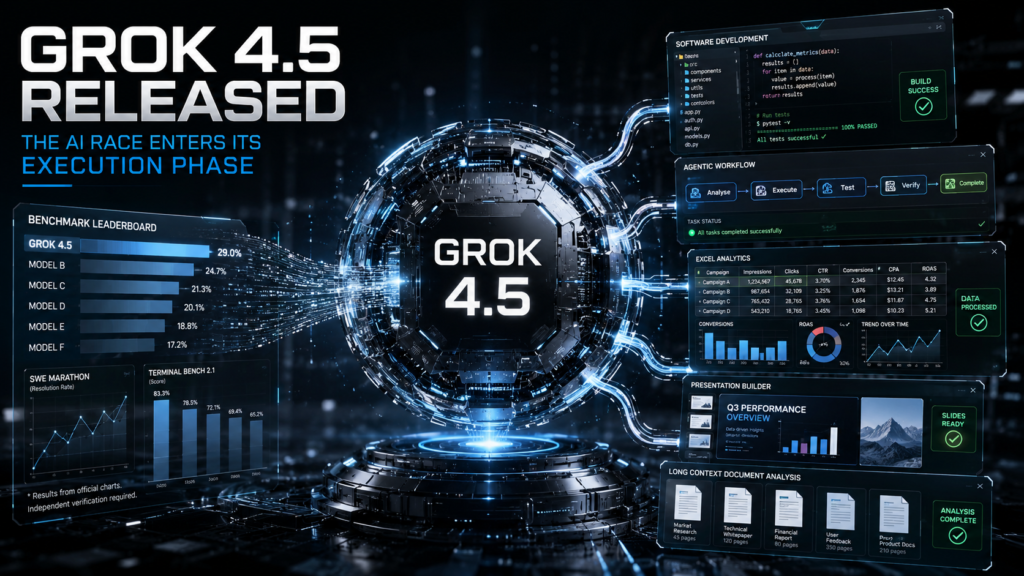
On SWE Marathon, Grok 4.5 recorded a 29 per cent resolution rate, ahead of the comparison models included in the company’s chart. On Terminal Bench 2.1, it scored 83.3 per cent, placing it close to the leading results.
However, the model ranked behind other systems on DeepSWE 1.0, DeepSWE 1.1 and SWE Bench Pro. ed performance is more informative than a perfect sweep. Different benchmarks measure different forms of coding competence, and results can vary according to the evaluation harness, reasoning budget, tool configuration and testing method.
The reasonable conclusion is not that Grok 4.5 has won the coding race. It is that the model appears competitive at the frontier, with notable strength in long-running engineering work.
These remain vendor-published results. They should be independently tested before businesses base major development or automation decisions on them.
Speed and Token Efficiency May Matter More Than Rank
One of the most commercially relevant claims is that Grok 4.5 is served at around 80 tokens per second.
The company also says the model used an average of 15,954 output tokens on SWE Bench Pro tasks, compared with 67,020 for Anthropic’s Opus 4.8 at its maximum setting. That represents roughly 4.2 times fewer output tokens in the cited evaluation. ters because the economics of agentic AI differ from the economics of ordinary chat.
A conventional question-and-answer interaction may consume a limited number of tokens. A coding agent may repeatedly read context, generate commands, interpret results, inspect errors and attempt additional fixes. Inefficiency compounds quickly when an agent is allowed to work through dozens of steps.
Grok 4.5 is priced at $2 per million input tokens and $6 per million output tokens. Cached input is listed at $0.30 per million tokens. These rates are commercially aggressive, particularly if the claimed token efficiency survives independent testing. A pest model is not necessarily the most economical model. A system that requires repeated corrections, retries and human review can become expensive despite having a lower advertised token price.
Real cost must therefore be measured against successful task completion, not token consumption alone.
A 500,000-Token Context Window
Grok 4.5 supports a 500,000-token context window, with text and image input and text output. This allows it to process sizeable repositories, technical documents, research material or long agent histories within a single working session. Size, however, should not be confused with understanding.
A model can accept a large amount of information while still missing critical details, prioritising irrelevant material or losing track of earlier instructions. The real test is how effectively it selects, connects and retrieves relevant information during long tasks.
For developers, the larger context window may reduce the need to divide repositories into extremely small sections. For researchers and professional teams, it may allow the model to work with multiple reports, spreadsheets, documents and reference materials together.
However, adding more information does not automatically produce a better result. Long-context workflows still require careful document selection, clear instructions and verification of the final output.
Beyond Developers: Grok Moves into Office Work
The release is not limited to programming.
The company says Grok 4.5 can build complex Excel models involving web research, multiple sheets and formulas. It is also being positioned for PowerPoint and Word work, including diagrams, slide creation and long-form writing. strategically important. The largest commercial market for AI may not be people asking questions. It may be professionals delegating parts of everyday work, such as preparing reports, checking data, producing presentations, analysing documents and maintaining operational systems.
For agencies and marketing teams, potential use cases include analysing campaign exports, cleaning datasets, producing performance summaries, creating spreadsheet models and automating repetitive research.
A marketing agency could potentially use the model to examine advertising data, identify unusual performance changes and convert the findings into a client report. A development team could use the same model to investigate a software issue, modify the relevant files and run tests.
Yet a coding-first model does not automatically possess strong marketing judgement, brand sensitivity or factual reliability. Those capabilities must be tested directly rather than assumed from software-engineering benchmarks.
What Grok 4.5 Means for the AI Market
Grok 4.5 shows that competition is moving away from general conversation and towards execution.
Model developers are increasingly competing over coding, tool use, long-context work and autonomous task completion. The objective is no longer simply to generate an impressive response. It is to complete a useful piece of work.
In this environment, the best model may not be the one with the highest average benchmark score.
Businesses will care about completion rate, speed, predictability, integration quality, security and the cost of correcting failed work. A model that ranks slightly lower on a benchmark but completes a company’s real tasks more reliably may be the better commercial choice.
The release also strengthens Grok’s position as a developer platform. Availability through familiar API patterns, Cursor and Grok Build reduces the friction involved in testing it inside existing workflows.
Grok Build has also been released as open-source software, allowing developers to inspect elements such as its agent loop, context assembly, tool dispatch system and extension framework. s not make the underlying Grok 4.5 model open source. It does, however, provide greater visibility into the system responsible for connecting the model with tools and development environments.
The Missing Piece: Independent Evidence
The launch provides detailed performance and pricing claims, but the evidence is still largely controlled by the company releasing the model.
There is no substitute for independent evaluation across real software repositories, business documents and production tasks.
Teams considering Grok 4.5 should measure whether it completes their work correctly, how often human intervention is required, whether its changes introduce hidden problems and how total costs change after retries and review time are included.
This is especially important for agentic systems.
An incorrect chatbot produces a bad answer. An incorrect agent can modify files, execute commands, change data and create operational consequences.
Businesses should therefore begin with controlled environments, limited permissions and clear review processes. Autonomous access should expand only after the system demonstrates consistent reliability within the organisation’s actual workflows.
Final Verdict
Grok 4.5 is a serious release because it presents a clearer vision of what the next generation of AI products may become.
The model is not merely trying to speak better. It is trying to work.
Its strongest story is the combination of competitive coding performance, fast generation, a large context window, tool use, configurable reasoning and aggressive API pricing.
Its benchmark record is impressive but mixed, which makes declarations of outright leadership premature.
The practical verdict will depend on whether Grok 4.5 completes real tasks with fewer failures, fewer tokens and less supervision than its competitors.
If it can, this release may prove more important than any leaderboard position. If it cannot, it will become another powerful model whose marketing moved faster than its reliability.
For now, Grok 4.5 should be viewed neither as an automatic winner nor as a minor upgrade. It is a credible frontier model and a clear signal that the AI race is entering its execution phase.
Frequently Asked Questions
When was Grok 4.5 released?
Grok 4.5 became available through the xAI API on 8 July 2026. The broader official launch announcement was published on 16 July 2026.
What is Grok 4.5 designed for?
It is primarily designed for coding, agentic tasks, engineering workflows and professional knowledge work.
What is the Grok 4.5 context window?
The official model documentation lists a 500,000-token context window. much does the Grok 4.5 API cost?
Standard pricing is listed at $2 per million input tokens and $6 per million output tokens. Cached input tokens are priced separately at a lower rate. rok 4.5 the best coding model?
The official benchmarks show competitive performance and leadership on selected tests, but Grok 4.5 does not rank first on every evaluation. Independent testing is required before making a definitive claim.