

Introduction
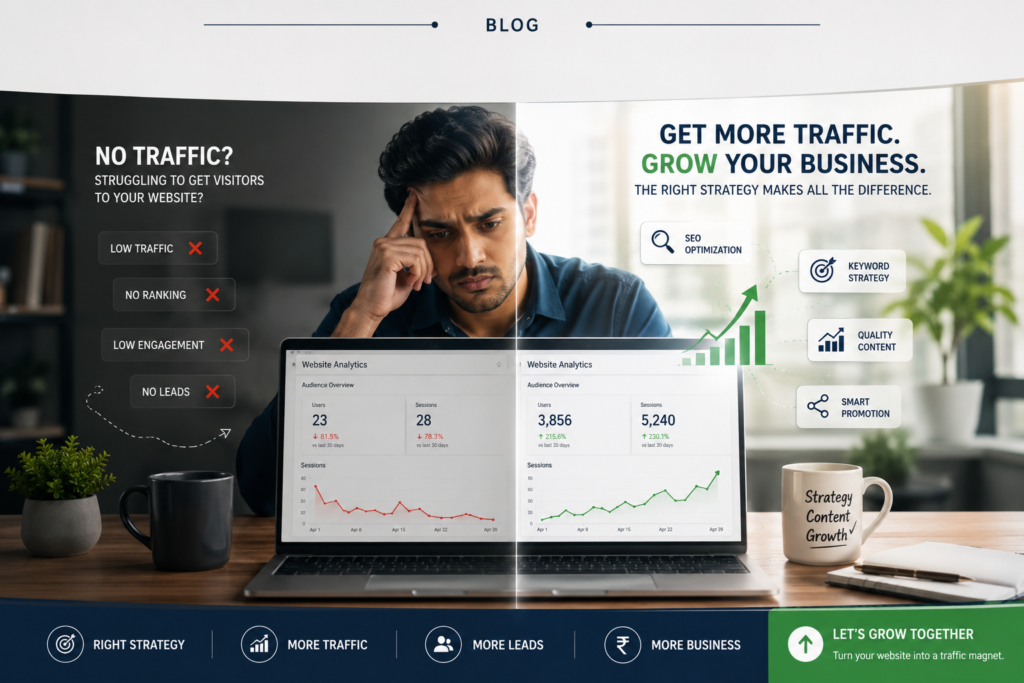
You have invested in building a website for your business. The design looks clean, your services are clearly listed, and everything appears to be in order. Yet, the traffic is missing.
This situation is more common than most business owners realise. A website by itself does not attract visitors. Without the right digital strategy, even a well-designed website remains unnoticed.
Understanding the reasons behind low traffic is the first step towards fixing the problem.
Lack of a Clear SEO Foundation
Search engines are the primary source of website traffic. If your website is not optimised properly, it simply will not appear when potential customers search online.
Many businesses overlook the basics. Pages are published without proper keyword targeting. Meta titles and descriptions are either missing or poorly written. Content is not structured in a way that search engines can understand.
The solution begins with building a strong SEO foundation. Every page should be created with a clear purpose. Keywords must be selected based on what your audience is actually searching for. Content should be structured logically so that both users and search engines can navigate it easily.
Targeting the Wrong Audience Through Keywords
Another major issue lies in keyword selection. Businesses often aim for very broad or highly competitive keywords. While these may seem attractive, they rarely bring results for new or growing websites.
At the same time, some websites use keywords that have little to no search demand. In both cases, the outcome is the same. Low or no traffic.
A more effective approach is to focus on specific, intent-driven keywords. These are the phrases that reflect real user needs. When your content matches what people are searching for, your chances of visibility improve significantly.
Content That Does Not Add Value
Content plays a critical role in attracting and retaining visitors. However, many websites either lack content or publish information that does not truly help the user.
Visitors are not looking for generic descriptions. They are searching for answers, clarity, and solutions. If your website does not provide this, they will leave quickly.
Creating valuable content requires understanding your audience. What are their challenges? What questions do they have before making a decision? When your content addresses these points in a simple and practical manner, it naturally performs better.
Poor Website Experience
User experience has a direct impact on traffic and engagement. A slow or poorly structured website discourages visitors from staying.
In many cases, websites take too long to load due to heavy images or inefficient hosting. Navigation is unclear, making it difficult for users to find relevant information. These issues not only affect users but also influence search engine rankings.
Improving website performance is not complicated, but it requires attention to detail. Faster loading speed, clean design, and smooth navigation can significantly improve user retention.
Ignoring the Mobile Audience
In India, a large portion of internet users access websites through mobile devices. If your website is not optimised for mobile, you are missing a significant opportunity.
A mobile-friendly website is no longer optional. It should load quickly, display content properly, and allow users to navigate without difficulty. When the mobile experience is smooth, users are more likely to stay and explore further.
No Consistent Promotion Strategy
Many businesses assume that once a website is live, traffic will start automatically. This expectation often leads to disappointment.
In reality, promotion is essential. Your content needs to reach your audience through multiple channels. Social media, search engines, and even email communication play a role in driving visitors.
A consistent approach to promotion ensures that your website remains visible and relevant. Over time, this builds awareness and trust.
Overlooking Local Search Opportunities
For businesses targeting a specific city or region, local visibility is extremely important. Yet, it is often neglected.
Without local optimisation, your website may not appear in searches made by nearby customers. This results in missed opportunities, especially for service-based businesses.
Focusing on local SEO helps bridge this gap. When your website is aligned with location-based searches, it becomes easier for potential customers to find you.
The Real Impact of Fixing These Issues
Once these areas are addressed, the improvement is gradual but noticeable. Your website starts appearing in search results. Visitors begin to engage with your content. Enquiries slowly increase.
It is important to remain patient during this process. Digital growth does not happen instantly, but with consistent effort, the results are sustainable.
Conclusion
Low website traffic is not a sign of failure. It is usually a sign that the strategy needs refinement.
When you focus on the right elements such as search optimisation, meaningful content, and user experience, your website can become a strong asset for your business.
The goal is not just to attract visitors, but to attract the right audience and convert them into customers.
Looking Ahead
If you find it challenging to manage these aspects on your own, seeking professional guidance can make the process more effective. With the right support, your website can move from being inactive to becoming a consistent source of business growth.