
Introduction
Two business owners in the same city, selling the same service, with the same monthly marketing budget. One puts it into SEO. The other runs Google Ads. A year later, their results look completely different. Not because one channel is better than the other, but because they each suit a different stage, goal, and type of business.
The SEO vs Google Ads debate comes up constantly, and most answers online are either too generic or quietly biased toward whichever service the agency writing the article happens to sell. This is a straight comparison built around what actually works for small businesses in India, not what sounds impressive in a pitch.
What SEO Delivers and What It Actually Costs You
SEO is the process of improving your website so it appears higher in Google’s organic search results when people search for what you offer. No cost per click. No ad spend. Just consistent work over time that builds a ranking your competitors have to earn their way past.
The honest reality about SEO is that it is slow at the start and fast to compound later. Most small businesses in India see their first meaningful ranking movement between three and six months. Reaching a stable Page 1 position typically takes six to twelve months of consistent, quality work. That timeline frustrates business owners who need leads this month, and it is the most honest reason to consider Google Ads alongside it.
But here is what makes SEO worth the wait. Once your pages rank, they keep delivering traffic without ongoing payment per click. A blog post that ranks on Page 1 for “best furniture shop in Jabalpur” today will still be delivering enquiries twelve months from now. The cost per lead from organic search drops consistently over time as the same work keeps paying off. For small businesses with limited monthly budgets, that compounding return is extremely valuable.
What Google Ads Delivers and What It Actually Costs You
Google Ads puts your business at the top of search results immediately, for whatever keywords you choose, as long as you keep paying. The moment your campaign is live, you can appear above every organic result for your target search terms. For a new business or a seasonal promotion, that immediate visibility is genuinely useful.
The cost structure is the critical thing to understand. You pay every time someone clicks your ad, whether they buy, enquire, or leave immediately. For local service businesses in India, cost per click typically ranges from 8 to 60 rupees depending on the industry and competition level. A plumbing service in a mid-sized city like Jabalpur might pay 15 rupees per click. A lawyer or a real estate developer in Mumbai might pay 80 to 120 rupees per click. These costs add up fast, especially when a significant portion of clicks do not convert into enquiries.
The other reality about Google Ads is that results stop the moment the budget stops. There is no residual benefit. A business that runs ads for eight months and then pauses returns to the same organic position it had before the ads started. Nothing is built. The investment does not compound.
How to Think About the Choice for Your Specific Business
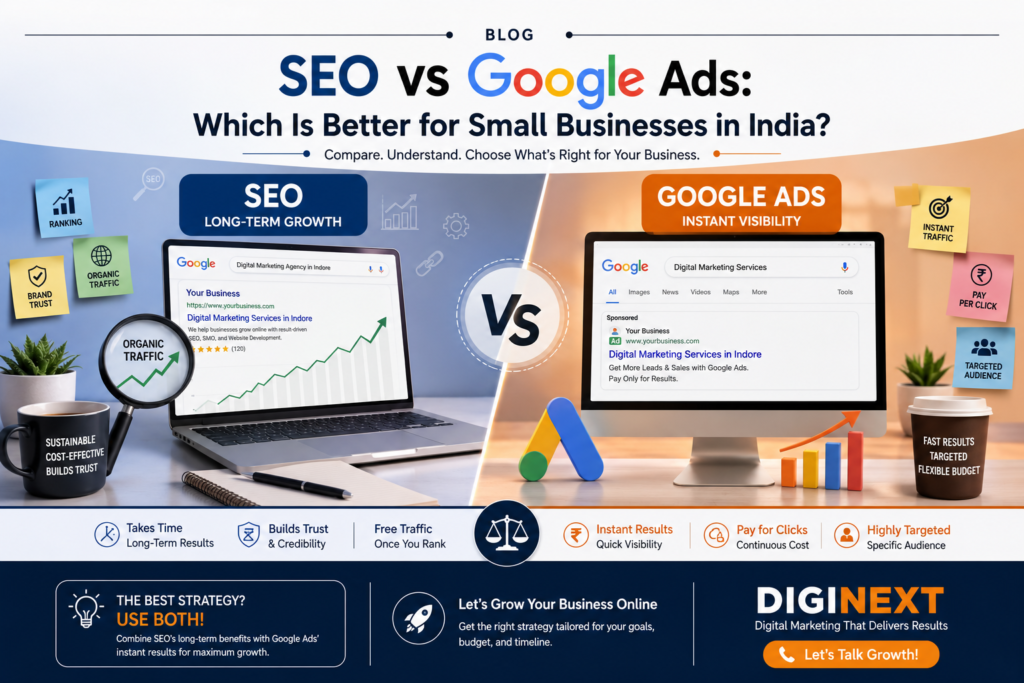
Neither channel wins universally. The right answer depends on three things: how urgently you need leads, how competitive your local market is, and how much budget you have to sustain the strategy.
Google Ads makes more sense when:
- You need enquiries within the next 30 days, not the next six months
- You are launching a new business with no organic presence yet
- You are promoting a seasonal offer or a time-limited service
- Your average order or project value is high enough to justify the cost per lead
SEO makes more sense when:
- You are building for the long term and can absorb the three to six month ramp-up period
- Your budget is limited and you need a channel that keeps delivering without ongoing spend increases
- You are in a local market where search competition is manageable
- You want to reduce dependence on paid platforms that can change pricing or policies at any time
For most small businesses in India operating in cities like Jabalpur, the smartest approach is to run both together but not equally. Start Google Ads for immediate lead flow while SEO builds in the background. As organic rankings establish themselves over six to twelve months, reduce ad spend gradually on the keywords where you are already ranking organically. Over time, the cost per lead from your total marketing spend drops as organic traffic takes on more of the load.
The Numbers That Actually Matter When Comparing Both
Most comparisons between SEO and Google Ads focus on cost to start. The more useful comparison is cost per lead over time.
A small business spending five thousand rupees per month on Google Ads might generate fifteen to thirty leads per month depending on industry and campaign quality. Cost per lead: roughly 170 to 330 rupees. That number stays roughly the same every month as long as the spend continues.
A small business investing the same five thousand rupees per month into SEO over twelve months will typically see organic lead volume grow from near zero in month one to fifteen to forty leads per month by month twelve, with the cost per lead dropping every month as the same investment keeps delivering more. By month eighteen, the cost per organic lead is often a fraction of what the equivalent Google Ads lead costs.
This is not an argument against Google Ads. It is an argument for understanding which metric actually matters for your business at which stage.
Real Questions Business Owners Ask About SEO vs Google Ads
1. Can I run SEO and Google Ads at the same time on a small budget?
Yes, and for most small businesses this is actually the most practical approach. Allocate a portion of your monthly budget to Google Ads for immediate visibility while the remaining portion funds ongoing SEO work. As SEO rankings build over six to twelve months, you can reduce ad spend on keywords where you are already showing up organically. The two channels complement each other rather than compete, and running both gives you data from paid campaigns that directly informs your SEO keyword strategy.
2. Which channel gives better quality leads for local service businesses in India?
SEO typically delivers higher intent leads because the person found you organically, read enough about your business to click, and arrived at your page without being interrupted by an ad. Organic visitors tend to spend more time on site and convert at a higher rate than ad traffic. Google Ads, however, can be highly targeted by location, time of day, and specific search terms, which means a well-managed campaign can also deliver strong quality leads. The gap in lead quality narrows significantly with a well-built landing page and proper campaign targeting.
3. Is SEO still worth investing in now that Google shows AI Overviews at the top of results?
Yes, and in some ways more so. Google AI Overviews pull their content from well-structured, authoritative pages that rank well organically. A page that ranks on Page 1 is far more likely to be cited in an AI Overview than a page on Page 3. Strong SEO builds the foundation that feeds both traditional rankings and AI search visibility simultaneously. Businesses that abandon SEO in response to AI search changes are making the opposite of the right move.
4. My Google Ads campaign is running but I am getting clicks without calls. Is this an SEO problem or an Ads problem?
This is almost always a landing page problem rather than either an SEO or Ads problem specifically. When people click an ad and do not convert, it means the page they land on is not matching their expectation or not giving them a clear enough reason to act. Check whether your landing page matches the promise of the ad, whether your phone number is prominent and clickable on mobile, and whether the page loads within three seconds. These fixes improve conversion rate regardless of whether the traffic source is paid or organic.
5. How do I know which keywords to target with SEO versus Google Ads?
A practical rule for small businesses: use Google Ads for high-intent, high-competition keywords where organic ranking will take twelve months or more. Use SEO for local and niche keywords where Page 1 rankings are achievable in three to six months. Over time, shift budget from Ads to SEO on keywords where organic rankings are established. Your paid campaign data also tells you which keywords convert best, which is the most valuable input for deciding which terms to prioritise in your SEO content strategy.
The Decision That Grows With Your Business
SEO vs Google Ads is not a permanent either-or choice. It is a shifting balance that should evolve as your business grows, your rankings build, and your understanding of which channels deliver the best return in your specific market improves.
Start with what your business needs right now. Build toward what it needs in twelve months. And make sure every rupee in your marketing budget is tracked well enough to tell you whether it is working.
If you are a small business in Jabalpur trying to figure out the right balance of digital marketing services for your budget and goals, reach out to DigiNext at 8989996987 and get a clear, honest strategy built around your actual numbers.