
Introduction
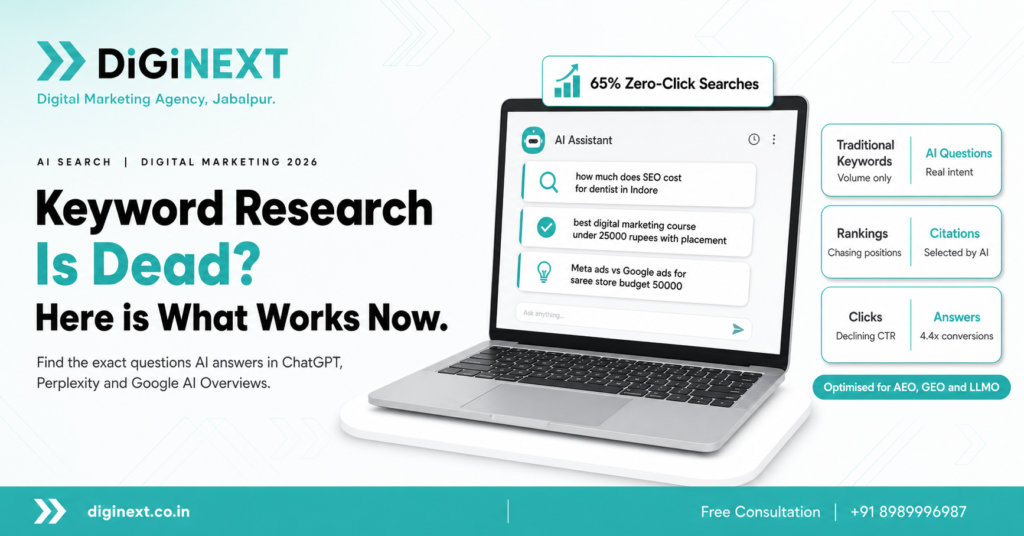
For ten years, most Indian agencies began every content plan with a spreadsheet of monthly volumes and keyword difficulty scores. In 2026, that habit is changing because Keyword research is dead as the only way to plan content. It has not disappeared, but Google AI Overviews, ChatGPT, Perplexity and Gemini now answer the user directly, often without a click. When 65 percent of searches end on the results page, chasing volume alone leaves you invisible where decisions are made.
The shift is simple to describe. Traditional keyword research tells you what people type. Answer Engine Optimization tells you what machines choose to quote. Your job now is to find the exact questions AI systems are being asked, then give them a clear, trustworthy answer they can reuse.
Why the old spreadsheet model is struggling in India
Three changes have made volume-first planning less useful.
First, search behaviour has become conversational. Users in Mumbai or Indore do not type best digital marketing course. They ask, ‘Which digital marketing course under 25000 rupees gives placement in Indore?’ AI engines prefer content that mirrors that full question.
Second, zero-click results have grown. Google now shows an AI summary for more than half of commercial queries. If your page is optimised only for a two-word phrase, the summary pulls from a competitor who answered the full question in the first paragraph.
Third, the cost of content has fallen, but trust signals matter more. Anyone can publish 50 articles for 10000 rupees using AI writers. What gets cited is content with first hand experience, local pricing, and clear structure. Volume data cannot tell you that.
What has replaced volume chasing
Marketers now work with three layers together.
- SEO for crawlability. Technical health, Core Web Vitals, and schema remain the base.
- Answer engine optimisation for direct answers. This is structuring content so it fits People Also Ask, featured snippets and AI overviews.
- Generative engine optimisation for entity trust. This is earning mentions on Reddit, LinkedIn, news sites and review platforms so AI models see you as a known source.
You do not abandon keyword tools. You use them to seed questions, then validate those questions where AI actually answers.
How to find the questions AI actually answers
Here is a repeatable method that works with Indian budgets and timelines.
Step 1: Start with real conversations, not tools
Open YouTube comments, Amazon reviews, Quora threads, and your own sales calls. Note the exact phrasing. A coaching institute in Pune found 37 variations of is digital marketing worth it after BCom, none of which appeared in their keyword tool.
Step 2: Mine AI surfaces directly
Type your seed topic into Google and copy every question from People Also Ask and AI Overview sources. Do the same in Perplexity and ChatGPT. Ask, what are the top 20 questions Indian small businesses ask about Instagram ads in 2026. Save the output. This gives you the language models already use.
Cost note for India: Perplexity Pro is about 1700 rupees per month. ChatGPT Plus is about 1950 rupees. Both are enough for research.
Step 3: Expand with question tools
Use AlsoAsked at 1500 rupees per month, AnswerThePublic at 999 rupees, or LowFruits at 2500 rupees for one time credits. These visualise question clusters. Export the list and remove duplicates.
Step 4: Check demand and intent
Paste the questions into Google Search Console to see impressions, not just clicks. A question with 80 impressions and 2 clicks often means AI is answering it above you. That is a priority. If you use Ahrefs Lite at about 16600 rupees per month or SEMrush Pro at about 12000 rupees, filter by questions with CPC above 20 rupees. High CPC indicates commercial intent even if volume is low.
Step 5: Validate with community proof
Search the question on Reddit and LinkedIn. If three or more threads exist in the last six months, the question is alive. AI models train on these discussions. Answering the same question on your site with clearer structure gives you a citation advantage.
A practical Indian workflow you can run this week
Monday: List 10 seed services you sell. For each, collect 15 questions from sales calls and WhatsApp enquiries.
Tuesday: Run those seeds through People Also Ask and Perplexity. You will have about 150 raw questions. Group them by intent: learn, compare, buy, troubleshoot.
Wednesday: Prioritise 30 questions that mention price, location, or timeline. Examples: how much does SEO cost for a dentist in Indore, how long to rank a new Shopify store in India, which is better Meta ads or Google ads for saree store under 50000 rupees budget.
Thursday: Write answer first drafts. Each page starts with a 40 to 60 word direct answer, then adds depth with local examples, rupee figures, and a checklist. Use FAQ schema.
Friday: Publish three pages, interlink them, and submit to Search Console. Track impressions for the exact question string, not just the head term.
Total tool spend for this workflow if you are starting out: 0 rupees for Search Console, 999 rupees for AnswerThePublic, 1700 rupees for Perplexity. If you hire a freelance researcher on platforms like WorkNHire, budget 5000 to 8000 rupees for the first 50 questions.
Traditional keyword research still has a role
It is fair to say Keyword research is dead only if you treat it as a finish line, not as a starting input. Volume data still helps you size a market. Difficulty scores still warn you away from terms dominated by large publishers. Search Console still shows which questions already bring you near page one.
The honest approach is to use both channels. Use keyword tools to find the universe. Use AI question mining to find the phrasing that gets quoted. One gives you scale, the other gives you selection. Brands that ignore the first waste effort on questions nobody asks. Brands that ignore the second publish pages that never appear in AI answers.
Measuring success beyond rankings
Stop reporting only position three for digital marketing agency. Start reporting:
- Citation rate: how often your brand appears in Perplexity or AI Overview sources for your top 20 questions
- Zero click visibility: impressions for question queries in Search Console
- Assisted conversions: users who first saw an AI answer quoting you, then visited later
- Cost per answer: total content spend divided by number of questions you own in AI results
A small agency in Ahmedabad spending 45000 rupees per month on content moved from tracking 120 keywords to tracking 45 questions. In four months, their AI citation rate rose from 4 percent to 31 percent, and qualified leads from organic rose by 22 percent without increasing ad spend.
Common mistakes Indian teams make
Writing answers that are too generic. AI prefers specific rupee ranges, city names, and timelines.
Burying the answer in the third paragraph. Put it first.
Publishing thin FAQ pages with no experience. Add screenshots, client data, or a short video transcript.
Ignoring Indian languages. Many questions are asked in Hinglish. Include one natural Hinglish variant per page.
FAQs
1. Do I need expensive tools to find AI questions?
No. Start with Search Console, People Also Ask, and Perplexity at 1700 rupees. Add AlsoAsked at 1500 rupees only when you need to scale.
2. How many questions should I target per month?
For a solo consultant, 8 to 12 well answered questions beats 50 thin posts. For a team of three, aim for 25 to 30.
3. Is this different from voice search optimisation?
It is similar but broader. Voice search focuses on assistants. AI answers include chatbots, overviews, and agents that complete tasks.
4. How long before I see results in AI overviews?
Typically 30 to 90 days after indexing if your page gives a direct answer, uses FAQ schema, and has at least two external mentions.
5. Should I still do traditional keyword research for e-commerce?
Yes. Use it for category architecture and inventory planning. Then layer question content for buying guides and comparisons.