
Introduction
The digital marketing landscape is shifting at an unprecedented pace. As we navigate through 2026, artificial intelligence, changing search behaviours, and privacy regulations have fundamentally reshaped how brands connect with their target audiences. Strategies that worked flawlessly in 2024 are now obsolete, requiring businesses to adapt or risk losing visibility in a hyper-competitive ecosystem.
For business owners, performance marketers, and agency leaders, understanding these shifts is not just about staying relevant; it is about driving predictable, profitable growth. From generative search experiences to hyper-personalised ad copy, the focus has moved from vanity metrics to genuine, revenue-generating engagement.
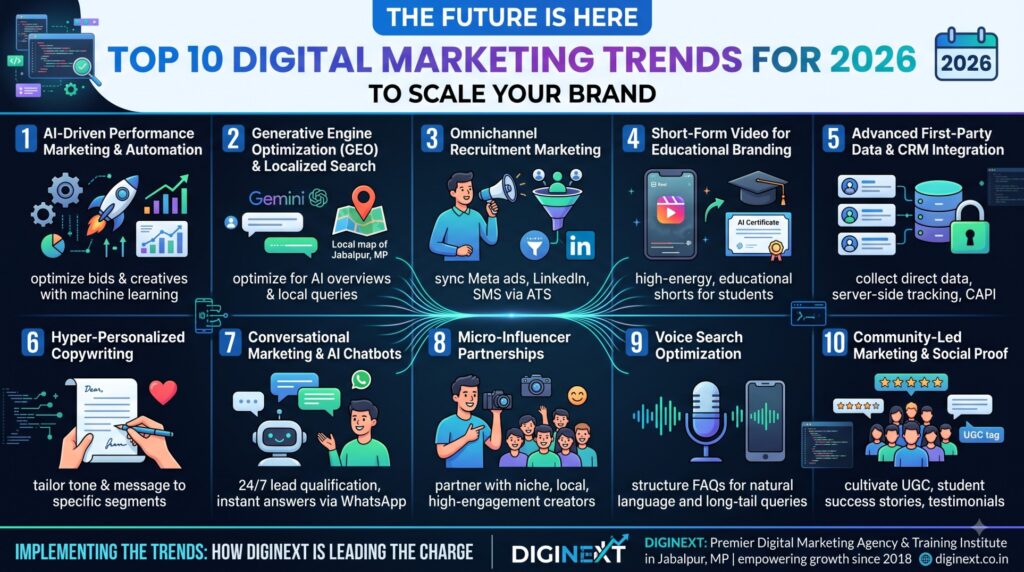
Here is a comprehensive breakdown of the 10 most critical digital marketing trends dominating 2026 and how you can leverage them to future-proof your business.
1. AI-Driven Performance Marketing & Automation
Artificial intelligence is no longer just a buzzword; it is the foundational layer of modern marketing. In 2026, AI is handling the heavy lifting in ad platforms, transitioning from a simple automation tool to a strategic asset that optimizes performance in real-time.
Modern performance marketing relies on machine learning algorithms to dynamically adjust bids, allocate budgets, and test thousands of creative variations simultaneously. For instance, AI tools can automatically swap background aesthetics—testing combinations of blue, red, and black—to identify the exact visual identity that maximizes conversion rates for a specific audience segment. This level of granular automation allows marketers to scale their Return on Ad Spend (ROAS) while dedicating more time to high-level strategy rather than manual adjustments.
2. Generative Engine Optimization (GEO) and Localized Search
Search Engine Optimization (SEO) has evolved into Generative Engine Optimization (GEO). Searchers are increasingly relying on AI overviews to get direct answers without clicking through multiple links.
To rank in this new environment, content must be optimized for AI-generated answers, focusing on conversational queries and deep expertise. Furthermore, localized GEO is becoming hyper-critical. For businesses operating in regional markets like Jabalpur, structuring local listings, embedding accurate service areas, and creating highly relevant localized content ensures that AI engines confidently recommend your services to nearby users. If your local SEO is weak, AI simply will not pull your brand into its direct answers.
3. Omnichannel Recruitment Marketing
Recruitment has fundamentally transformed into a specialized branch of digital marketing. Companies managing large-scale hiring drives—such as filling hundreds of customer support roles—can no longer rely solely on job boards.
In 2026, recruitment marketing requires a seamless omnichannel approach. This involves running highly targeted Meta lead-generation ads, executing automated LinkedIn outreach, and triggering SMS follow-ups. Integrating these channels directly into an Applicant Tracking System (ATS) ensures that the candidate journey is frictionless. By treating candidates exactly like high-value customers, businesses can drastically reduce their cost-per-hire and improve the quality of their talent pool.
4. Short-Form Video for Educational Branding
Attention spans are shorter, but the appetite for value is higher. Short-form video on platforms like Instagram Reels and YouTube Shorts continues to dominate engagement metrics.
This trend is particularly powerful for educational institutes, coaching hubs, and training academies. Instead of relying on static flyers to announce a new academic session or a summer AI course, successful brands are using high-energy, 30-second videos. A quick explainer breaking down a complex topic or a behind-the-scenes look at a classroom environment builds instant trust and authority, converting viewers into enrolled students far faster than traditional text posts.
5. Signal Loss and Privacy-First Data Strategies
With the continuous phase-out of third-party cookies and heightened browser restrictions, marketers are facing significant signal loss. Traditional tracking methods are breaking down, making it harder to attribute conversions accurately.
The solution in 2026 is a hard pivot to first-party data and privacy-first marketing. Brands are aggressively building their owned audiences—through email lists, CRM systems, and direct lead generation forms. Utilizing technologies like Server-Side Tracking and Conversions API (CAPI) is now standard practice to ensure data flows securely between your website and advertising platforms. A robust CRM is no longer optional; it is the central nervous system of any successful marketing campaign.
6. Hyper-Personalized Copywriting
Personalization has shifted from being a unique differentiator to a baseline consumer expectation. In 2026, 75% of consumers are more likely to purchase from brands that deliver personalized content.
However, hyper-personalization goes beyond inserting a first name into an email subject line. It requires adjusting the tone, context, and emotional resonance of your copy to match specific audience segments. For example, during a festive campaign, replacing generic slang with emotionally grounded language—such as encouraging users to share a moment with their “loved ones”—creates a deeper, more authentic connection that drives brand loyalty.
7. Conversational Marketing and Intelligent Chatbots
Instant gratification is the currency of the digital age. Users expect immediate answers, whether they are browsing a real estate portfolio at noon or inquiring about a digital marketing course at midnight.
Conversational marketing via AI-powered chatbots and automated WhatsApp flows allows businesses to capture and qualify leads 24/7. These intelligent systems can guide a prospect through a qualifying questionnaire, schedule appointments, and seamlessly hand off high-ticket leads to human sales representatives. This ensures zero drop-off in the sales funnel and dramatically improves lead response times.
8. The Shift to Micro-Influencer and Creator-Led Content
The era of massive, expensive celebrity endorsements is waning, giving way to creator-led content and micro-influencers. Consumers are highly skeptical of polished, highly produced advertisements, favoring raw, authentic recommendations from creators they trust.
Partnering with local micro-influencers—creators with smaller but highly engaged, regional followings—yields significantly higher conversion rates. For local businesses, retail brands, and hospitality venues, a genuine review or a vlog-style walkthrough from a trusted local voice provides the social proof necessary to drive foot traffic and localized sales.
9. Voice Search and Interactive Audio
As smart speakers and voice-activated assistants become ubiquitous, search queries are becoming longer, more conversational, and highly specific.
Optimizing for voice search requires a shift in content strategy. Instead of targeting fragmented keywords, marketers must build FAQ sections and long-form content that directly answers spoken questions (e.g., “Where can I find the best performance marketing agency in my city?”). Brands that structure their website data to cater to these conversational queries are capturing a massive, often overlooked, segment of search traffic.
10. Human-First Content and E-E-A-T
Paradoxically, as AI content generation explodes, the value of genuine human experience has skyrocketed. Search engines and users alike are prioritizing content that demonstrates real-world expertise and authenticity.
Google’s E-E-A-T (Experience, Expertise, Authoritativeness, and Trustworthiness) framework is the governing law of content marketing in 2026. While AI can help outline and draft, the final product must include unique insights, real case studies, and human nuance. Brands that mindlessly publish unedited AI content are seeing their search rankings plummet, while those who inject human-first value are dominating the SERPs.
Implementing the Trends: How DIGINEXT is Leading the Charge
Understanding these trends is only half the battle; executing them requires specialized expertise. This is where an experienced partner becomes invaluable.
Based in Jabalpur, DIGINEXT stands at the forefront of this digital evolution as a premier digital marketing agency and training institute. Helping local businesses, educational institutes, and retail brands grow their online footprint, DIGINEXT specializes in turning these complex 2026 trends into measurable, revenue-driving results.
Whether it is leveraging AI-powered Meta and Google Ads, executing deep local SEO strategies, or crafting compelling social media campaigns, DIGINEXT focuses on practical, data-backed execution. Beyond agency services, their AI-powered digital marketing training programs empower the next generation of marketers and business owners to master these tools themselves. By combining a deep understanding of the local Jabalpur market with advanced, global performance marketing strategies, DIGINEXT ensures that businesses do not just keep up with the digital shift—they dominate it.
Conclusion
The digital marketing playbook for 2026 is defined by the intersection of advanced technology and authentic human connection. By embracing AI automation, optimizing for generative search, respecting user privacy, and delivering hyper-personalized experiences, brands can build resilient, high-growth marketing engines. The tools have never been more powerful—success now belongs to those who know how to wield them effectively.