
Introduction
Every business owner reaches the same fork in the road at some point. You know you need to build a brand online. But should you be building your own name and reputation, or should you be building the company’s identity? Should your Instagram be about you personally or about the business? Should you be creating content as a founder or as a brand?
The personal brand vs company brand question does not have a universal answer, but it does have a right answer for your specific situation. Getting this wrong means either building an audience that does not transfer to business growth, or building a faceless company brand that struggles to create trust in competitive markets. Here is how to think through the decision clearly.
What a Personal Brand Actually Is and What It Is Not
A personal brand is the reputation and recognition built around an individual person. It is what people think of when they hear your name. What expertise they associate with you. What they expect from you. What they tell others about you.
For a business owner, a personal brand means people know who you are before they know what your company does. They follow your content because they find your perspective valuable. They trust your recommendations because they trust you specifically. When they need a service in your category, they think of you by name, not just by company name.
A personal brand is not the same as being famous or having a large social media following. A business owner in Jabalpur with 2,000 followers who are all local professionals in relevant industries has a stronger personal brand than someone with 50,000 followers spread randomly across the country. The value of a personal brand comes from the right people knowing who you are and trusting your expertise, not from raw follower numbers.
The most powerful personal brands in local business markets are built around genuine expertise and consistent, valuable communication. A lawyer who writes weekly about common legal mistakes small businesses make. A nutritionist who shares honest, research-backed advice about diet myths. A digital marketing consultant who explains exactly how things work without hiding behind jargon. These people build personal brands because they give real value consistently, not because they chase followers.
What a Company Brand Actually Is and What It Does
A company brand is built around the business rather than around an individual. It has its own identity, voice, visual system, and reputation that exists independently of any one person. The brand can survive the departure of any individual team member, including the founder, because it does not depend on any one person’s personality or presence.
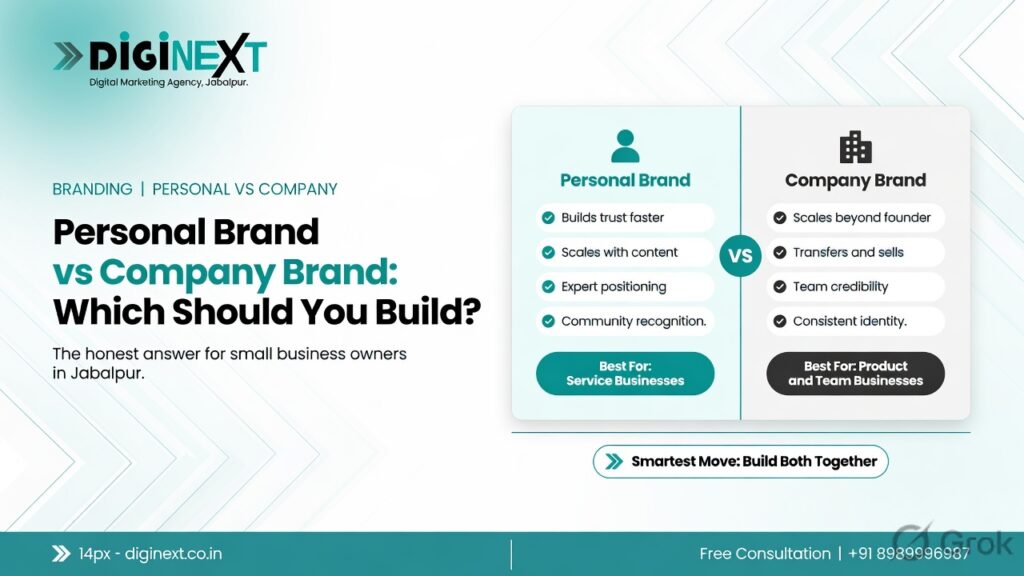
Strong company brands are powerful because they scale. A personal brand is limited by how much one person can create and communicate. A company brand can have multiple people creating content, serving customers, and building reputation under the same umbrella. As the business grows, the brand grows with it without depending on the founder being the face of everything.
Company brands also transfer and sell more easily. If a business owner ever wants to sell the business, step back from operations, or bring in a partner, a company brand has value independent of the individual. A personal brand tied completely to one person’s identity has much less transferable value.
The challenge with company brands for small businesses is that they are harder to build trust with initially. A person is easier to connect with emotionally than a logo. Customers naturally trust people more than they trust organisations, especially in the early stages of a relationship.
When a personal brand is the Stronger Choice
Personal branding works best in specific situations. Understanding these helps you decide whether this is the right direction for your business.
If you are a service provider where the customer is buying your personal expertise, judgment, or relationship, a personal brand is almost always more powerful. Lawyers, doctors, consultants, coaches, designers, photographers, and financial advisors all fall into this category. The customer is choosing you specifically, not just your company. Building your name as a trusted expert in your field directly drives business in a way that building a company brand for the same business might not.
If your target market is the same people who are active on LinkedIn, Instagram, or other platforms where personal content performs well, personal branding gives you a distribution advantage. Content from individuals consistently outperforms content from company accounts on most social platforms because the algorithms favour personal communication over corporate messaging.
If you are in a highly competitive local market where customers have many similar options, being known personally in that community creates a relationship advantage that no company brand can replicate at the same cost. A business owner in Jabalpur who is known by name among the local business community has a networking and referral advantage that takes years for a faceless company brand to develop.
When Company Brand is the Stronger Choice
Company branding makes more sense when the business is not fundamentally dependent on one person’s expertise or relationship. A product business, a retail store, a manufacturing company, a restaurant, or a software product does not need its founder to be personally famous to build a strong brand. The product or service experience creates the brand impression, not an individual’s content.
If you have or plan to have a team delivering services under your company’s name, building a company brand distributes the credibility across the organisation rather than concentrating it in one person. This makes the business more robust and makes growth easier because new customers are buying from the company, not waiting specifically for the founder.
If your exit strategy involves selling the business at some point, building a company brand is essential. A business where all the brand equity lives in the founder’s personal reputation is significantly harder to sell than one where the brand identity is clearly attached to the company.
The Smartest Approach for Most Local Business Owners
For most small business owners in Jabalpur, the answer is not either-or. It is a combination with a clear priority depending on stage.
In the early stages of a business, a personal brand typically builds faster and with less effort than a company brand. People connect with people. A founder who is visible, communicates their expertise honestly, and shows up consistently in the local market builds trust and generates referrals faster than a new company brand with no recognition.
As the business grows and stabilises, the personal brand should be used to elevate the company brand rather than replace it. Content from the founder references the company. The founder’s expertise positions the company as the credible choice. The company brand is what the customer ultimately buys from, and the personal brand is what gets them over the trust threshold to do so.
The businesses in Jabalpur that combine these two approaches effectively, a visible, credible founder with a professionally built company brand, consistently outperform businesses that focus entirely on one or the other.
Real Questions Business Owners Ask About Personal vs Company Branding
1. Can I build both a personal brand and a company brand at the same time?
Yes, and for most small business owners this is actually the most effective long-term approach. The personal brand accelerates trust building and audience growth in the early stages. The company brand builds the identity and reputation that outlasts any individual. Running both simultaneously requires more content and more consistency, but the combination is significantly more powerful than either alone. Start with whichever feels more natural and build the second alongside it over time.
2. What happens to my business brand if my personal brand gets negative attention?
This is one of the real risks of tying personal and company brands too closely together. If your personal reputation takes a hit, the company brand can be affected. This is why even business owners who invest heavily in personal branding should ensure the company has its own distinct identity, values, and reputation that can stand independently. Think of the personal brand as amplifying the company brand, not replacing it. Keep them connected but not identical.
3. I am an introvert and uncomfortable being the face of my business. Can I still build a strong brand?
Absolutely. Personal branding does not require being extroverted, creating videos, or being constantly visible on social media. Some of the most effective personal brands are built through written content, through a well-crafted LinkedIn presence, or through being known as the go-to expert in a specific community without any social media presence at all. Find the format that suits your personality and do that consistently. The medium matters far less than the consistency and quality of the communication.
4. Does personal branding work differently for women-owned businesses in Jabalpur?
The fundamentals are the same but the context and community dynamics can differ. Women entrepreneurs who build strong personal brands in Jabalpur often find that their network of other women in business, local entrepreneurship communities, and digital platforms like LinkedIn are particularly effective channels. The trust signals that resonate may differ slightly from those that work for male-owned businesses. Working with a branding professional who understands local market dynamics can help tailor the approach appropriately.
5. If my business name is my own name, is that already a personal brand?
Using your own name as the business name is a starting point but not a personal brand by itself. A personal brand is built through consistent, visible, valuable communication that establishes your expertise and reputation in a specific area. A business named after its founder that never communicates publicly or builds the founder’s reputation is not a personal brand. It is just a business with a personal name. The brand requires active, intentional building regardless of what the business is called.
The Right Brand Strategy is the One That Fits Your Business Model
Personal brand vs company brand is ultimately a question of what your business model requires, what stage you are at, and what you are comfortable sustaining consistently over time. There is no universally correct answer, only the answer that fits your specific situation.
What matters most is making a deliberate choice, committing to it with consistency, and building it with the same professional care you bring to every other aspect of your business.