

Introduction
You know your product is better. Your prices are fair. Your service is good. Yet customers keep choosing the competitor down the road, the one with the flashier Instagram, the more professional website, or simply the name they have heard more often. It is one of the most frustrating experiences in business, and most owners never get a straight answer about why it is happening.
The truth is that why customers choose competitors almost never has anything to do with the actual quality of the product or service. It has to do with perception, trust, visibility, and the dozen small signals customers read before they ever experience what you actually offer. By the time a customer walks through your competitor’s door, they have already made a decision based on things you probably never thought about.
Here is the uncomfortable, specific breakdown of exactly what is happening and what needs to change.
Problem 1: Your Competitor Looks More Credible Before the Customer Even Contacts Them
Credibility is built before the first conversation. When a potential customer in Jabalpur is deciding between two businesses in the same category, they are not evaluating quality. They cannot evaluate quality yet because they have not experienced either business. They are evaluating signals of quality. And those signals are almost entirely visual and reputational.
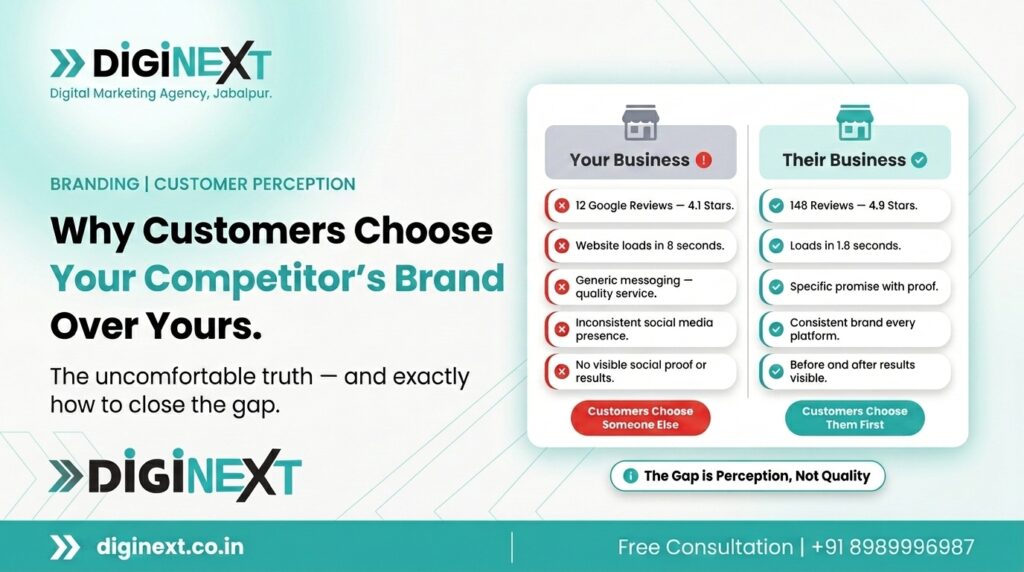
Your competitor’s website loads in two seconds. Yours takes seven. Your competitor’s logo looks professional and consistent across every platform. Yours looks slightly different on Instagram than on the website than on the business card. Your competitor has 140 Google reviews with a 4.8 rating. You have 12 reviews and a 4.1. Your competitor’s Instagram has a consistent visual style that looks like they take themselves seriously. Yours has a mix of different styles, random fonts, and posts that feel like they were made in a hurry.
None of these things tell the customer anything about the actual quality of the product or service. But they tell the customer everything about which business takes itself seriously. And customers consistently choose the business that takes itself seriously, because they read that as a signal that the business will take them seriously too.
The damage here is silent. You never find out that customers visited your website and left because it loaded slowly. You never know that they compared your 12 reviews to the competitor’s 140 and made a decision before calling anyone. You just notice that the phone is quieter than it should be.
Problem 2: Your Competitor is Remembered and You Are Not
Memory is the invisible currency of local business competition. The customer who remembers your competitor’s name when the need arises is the customer your competitor gets, regardless of which business is actually better.
Memory is built through repeated exposure. Your competitor posts consistently on Instagram, shows up in Google results, sends WhatsApp updates to their customer list, and has their Google Business Profile appearing in local search results with regular photos and updates. Every one of these touchpoints is a small deposit into the customer’s memory bank. Over months of repeated exposure, that competitor’s name becomes the first one the customer thinks of when the need arises.
Your business might be doing some of these things some of the time. But inconsistency is the enemy of memory. A business that posts on Instagram for three weeks and then goes quiet for a month, that updated its Google Business Profile once a year ago and has not touched it since, that sends WhatsApp messages occasionally rather than on a regular schedule, is not building memory. It is building occasional awareness that fades between exposures.
The customer does not consciously decide to go to your competitor. They just think of that name when the need arrives because that is the name they have seen most recently, most consistently, and most clearly. The business that wins on memory wins the enquiry before anyone has spoken to anyone.
Problem 3: Your Competitor Has Social Proof and You Are Invisible on That Front
Social proof is the single most powerful trust signal available to any local business, and most small businesses in Jabalpur are losing customers every day because they are not collecting or displaying it effectively.
When a customer sees 200 Google reviews for your competitor with specific, detailed feedback from real customers, and then sees 8 reviews for your business with generic one-line responses, they do not need any other information. The social proof has already made the decision for them. Two hundred people cannot be wrong. Eight people is not enough to be confident.
The problem compounds on other platforms. Your competitor has before-and-after photos on Instagram. Customer testimonials on their website with names and photos. Case studies or result stories on their Google Business Profile. Every piece of this content is social proof that removes a layer of doubt from the customer’s decision-making process.
Your business might have equally happy customers, equally impressive results, and equally strong outcomes. But if none of that is visible, documented, and shared publicly, it does not exist in the customer’s decision-making process. The competitor with documented proof wins over the business with undocumented excellence every single time.
Problem 4: Your Competitor Communicates a Specific Promise and You Communicate a Generic One
Customers are making a purchasing decision under uncertainty. They do not know for certain which business will deliver the best outcome. To reduce that uncertainty they look for specific promises, specific proof, and specific reasons to trust.
Your competitor says “We complete all home renovation projects in Jabalpur within the agreed timeline or we give you a ten percent discount on the final bill.” That is a specific, memorable, confidence-building promise. It tells the customer exactly what to expect and exactly what happens if things go wrong. It removes uncertainty.
Your business says “We are committed to quality and customer satisfaction.” That tells the customer nothing they could not read at every other business in the same category. It removes no uncertainty whatsoever. The customer moves to the competitor who gave them something specific to hold on to.
The same dynamic plays out in every category. The coaching centre that says “Our Class 12 students improved their scores by an average of 28 marks last year” beats the one that says “We are dedicated to student success.” The restaurant that says “Every ingredient is sourced fresh from local suppliers every morning” beats the one that says “We serve quality food with love.” The specific beats the generic in every competitive situation because specificity communicates confidence, and confidence is what uncertain customers are looking for.
Problem 5: Your Competitor Has Built a Brand and You Are Running a Business
This is the deepest and most uncomfortable reason. Your competitor has an identity. Your business has operations.
An identity means customers know what the business stands for beyond the product or service it sells. They know the personality, the values, the specific type of customer it serves, the specific problem it solves best. They have a feeling about the business before they experience it. That feeling is what the competitor’s brand has built through consistent communication over time.
Running operations means delivering a good product or service to whoever comes in, without a clear identity, without a consistent communication strategy, and without a deliberate effort to build recognition and preference. The business works fine for the customers it already has. But it struggles to attract new ones because there is no clear signal that distinguishes it from every other option in the same category.
Brand building is the work of creating that identity and communicating it consistently until it becomes the first thing customers think of when they need what you offer. Most small business owners in Jabalpur understand this intellectually but have not prioritised doing it systematically. The competitor who started doing it two years ago now has a significant advantage that only more consistent brand building on your part will close over time.
Real Questions Business Owners Ask About Losing Customers to Competitors
1. How do I find out specifically why customers are choosing my competitors over me?
Ask them directly. Customers who have recently made a purchase in your category are the best source of information about what drove their decision. You can reach out to people who enquired but did not buy and ask what made them go elsewhere. You can survey existing customers about what almost made them choose a competitor. You can ask new customers what they noticed about you versus others they considered. Direct, honest conversation with customers reveals what no amount of market research can. Most people will tell you what they actually thought if you ask in a non-defensive, genuinely curious way.
2. Can I close the gap with a well-established competitor quickly?
Some gaps close quickly and some take time. Visual credibility, website quality, and Google Business Profile strength can be improved within weeks and the impact is almost immediate. Social proof takes longer because reviews need to be earned consistently over months. Brand recognition and memory take the longest because they require sustained, repeated exposure over twelve to eighteen months minimum. Prioritise the quick wins first: fix the website, build the Google Business Profile, and implement a systematic review collection process. These changes produce visible results faster than any other investment.
3. Should I look at what my competitors are doing and copy the elements that seem to work?
Study competitors to understand the baseline standards in your category, not to copy them. Copying what a competitor does puts you in a permanent position of following, never leading. The goal is to identify where competitors are falling short or where there are gaps they have not addressed, and build your differentiation around those gaps. A business that copies its competitors will always be the second-best version of those competitors. A business that identifies what competitors are not doing and does that exceptionally well becomes a genuine first choice for a specific segment of customers.
4. My competitor charges more than me but still gets more customers. How is that possible?
Because price is not the primary decision driver for most purchasing decisions in most categories. Customers pay more when they trust more. A competitor who has built stronger credibility signals, more social proof, a clearer specific promise, and a more recognisable brand has built the trust that justifies higher pricing. Customers who are unsure about quality often interpret higher prices as a signal of higher quality, especially when other trust signals are also stronger. Competing on price alone is a race to the bottom that damages the business. Competing on trust, credibility, and differentiation is a race that can actually be won.
5. What is the single fastest thing I can do right now to start winning customers back from competitors?
Build your Google Business Profile review count systematically. Identify your ten most recent happy customers and personally ask each one to leave a Google review today. Send them the direct review link so there is zero friction. Do this every week going forward with every new satisfied customer. Within three months, the review count and rating gap between you and your competitor will begin to close. This single change affects your Google search visibility, your Maps ranking, and the trust signal that customers see before they contact anyone. It is free, it is immediate, and it is consistently the highest-impact single action a local business can take.
The Gap Between You and Your Competitor is Not About Quality
The most important thing to understand about losing customers to competitors is that the gap is almost never about what happens inside your business. It is about what customers perceive before they ever experience what happens inside your business.
Fix the perception and the quality you already have starts winning. Continue ignoring the perception while focusing only on internal quality and the customers will keep choosing the competitor who looks better, sounds clearer, and is remembered more readily, regardless of what actually happens after the sale.
Why customers choose competitors over you is a solvable problem. It requires honest assessment of every signal your business is sending before the first conversation happens, systematic improvement of the weakest signals, and the consistency to build recognition and trust over the time it actually takes.