
Introduction
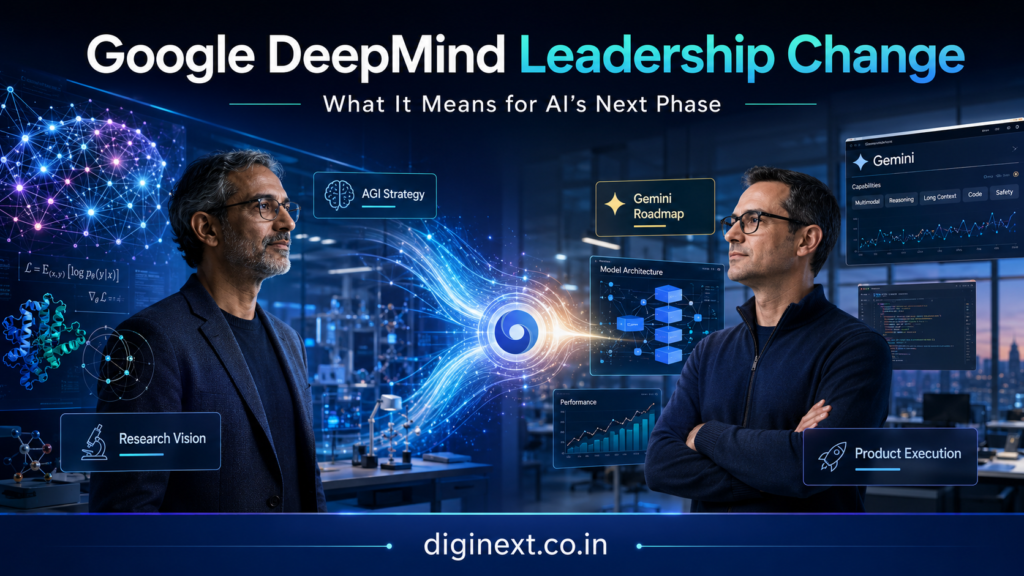
The Google DeepMind leadership change is bigger than a senior executive receiving a new title. Demis Hassabis is moving from the chief executive role at Google DeepMind to become its chair and Alphabet’s chief scientist. Koray Kavukcuoglu will take responsibility for the division’s daily operations as senior vice president of Google DeepMind.
On paper, this looks like a management reshuffle. In practice, it reveals a deeper challenge facing every major AI company: how to pursue transformative scientific research while releasing products quickly enough to remain commercially competitive.
Google is now separating those two responsibilities more clearly.
What Changed at Google DeepMind?
Google and Alphabet CEO Sundar Pichai announced the leadership changes on 5 August 2026.
Hassabis will no longer manage Google DeepMind’s daily operations. He will serve as chair of the division and take the newly created position of chief scientist at Alphabet. His work will focus more heavily on artificial general intelligence, scientific research and the broader consequences of advanced AI.
Hassabis will also continue leading Isomorphic Labs, Alphabet’s AI-based drug discovery company.
Koray Kavukcuoglu, previously Google DeepMind’s chief technology officer, will become senior vice president of Google DeepMind. He will report directly to Pichai while retaining his position as Alphabet’s chief AI architect.
His responsibilities include:
- Gemini model development
- Frontier AI research
- The Gemini application
- Google’s AI developer products
- Converting research progress into usable products
Google has not appointed Kavukcuoglu as the new DeepMind CEO. The company has instead given him operational control through the senior vice president role.
This distinction matters. Hassabis remains influential, but the person responsible for deadlines, product teams and execution has changed.
Why the Google DeepMind Leadership Change Matters
The official explanation focuses on artificial general intelligence.
Hassabis said he believes AGI is approaching and wants more time to consider its scientific, strategic and societal implications. Pichai described this work as important to both Alphabet and humanity.
That explanation is credible, but it is not the complete story.
Google DeepMind is also under intense commercial pressure. The division must compete with OpenAI, Anthropic and rapidly improving open models while supporting Search, Cloud, Android, Workspace and the Gemini app.
Frontier research and commercial execution do not always move at the same speed.
Scientific teams want time to test difficult ideas. Product teams need predictable releases, competitive pricing, stable performance and features customers can use now.
The leadership change appears designed to give Hassabis greater freedom to pursue the first objective while making Kavukcuoglu directly accountable for the second. This is an interpretation based on the new division of responsibilities, not an explanation Google has formally stated.
It may be the clearest sign yet that Google no longer considers AI research alone sufficient. The company needs research to become reliable products faster.
Google Is Separating Science from Product Execution
Hassabis has always approached AI primarily as a scientific project.
DeepMind’s best-known achievements include AlphaGo and AlphaFold, systems that demonstrated how machine learning could solve complex scientific and reasoning problems. Hassabis and John Jumper received the 2024 Nobel Prize in Chemistry for work connected to protein structure prediction.
That scientific identity remains central to his new role.
Hassabis said he wants to spend more time on global AGI strategy and Isomorphic Labs. He has repeatedly argued that improving human health should become AI’s most important application.
Kavukcuoglu’s assignment is more operational. Pichai said he will oversee the Gemini roadmap, frontier research, developer teams and consumer applications.
The structure now resembles a deliberate split:
Hassabis will focus on what advanced AI could become.
Kavukcuoglu will focus on what Google must deliver next.
For customers and developers, Kavukcuoglu’s role may have the more immediate impact. He will influence model releases, Gemini integrations, developer access, product reliability and the pace at which research reaches the market.
For Alphabet’s long-term scientific direction, Hassabis remains one of the company’s most important figures.
The Departures Make the Restructuring More Serious
The Google DeepMind leadership change did not happen in isolation.
Jeff Dean, Sanjay Ghemawat, Oriol Vinyals and Quoc Le are leaving Google to establish Discovery Loop, an independent public benefit corporation. Google will support the new company as a founding investor and cloud partner.
These are not routine employee departures.
Dean and Ghemawat contributed to important Google infrastructure, while Vinyals and Le played major roles in machine learning and the development of modern AI systems.
Discovery Loop plans to build systems that automate repeated scientific and engineering experiments. Its initial focus will be machine learning research, with the wider objective of accelerating scientific discovery.
Google’s investment suggests the relationship is not hostile. The company is allowing experienced researchers to operate independently while preserving a connection to their future work.
However, losing several influential researchers at the same time still creates execution risk.
Alphabet shares fell approximately 4 per cent following the announcement. A one-day market reaction does not prove that investors have lost confidence in Google’s AI strategy, but it shows that the restructuring was considered commercially significant.
What This Means for Gemini AI
Google says Kavukcuoglu will lead the teams responsible for Gemini models, the Gemini app and developer products.
Hassabis also confirmed that Google is working on new models, including Gemini 4. The company has not publicly released that model, so claims about its performance would be premature.
The leadership change could produce three outcomes.
Faster Product Decisions
Kavukcuoglu may be able to make faster decisions because he will oversee model research and product delivery together.
This could reduce the distance between a research breakthrough and its use in Search, Cloud or the Gemini app.
Greater Commercial Focus
Google Cloud, Workspace and Search need AI systems that are affordable, fast and dependable. Benchmark leadership matters, but businesses also care about integration, security, latency and cost.
The new structure may place more weight on these practical requirements.
More Pressure on the Gemini Roadmap
Clearer leadership also creates clearer accountability.
Kavukcuoglu will be judged by Google’s ability to release competitive models and turn them into products used by consumers, developers and enterprises.
The restructuring will not automatically improve Gemini. It simply makes responsibility for its execution easier to identify.
What Jabalpur Businesses Should Learn from Google’s Decision
A leadership change inside Alphabet may appear distant from the daily concerns of a hospital, school, hotel, retailer or service business in Jabalpur.
The lesson is still relevant.
Businesses often treat AI as one broad project. They ask one employee, agency or software provider to choose tools, develop workflows, create content, manage data and deliver commercial results.
Google’s restructuring demonstrates that AI strategy and AI execution are different responsibilities.
A local business needs someone to decide:
- Which business problem AI should address
- Which data the system can access
- Where human approval remains necessary
- How performance will be measured
- Who is responsible when the output fails
It also needs someone who can implement and maintain the workflow.
Buying access to Gemini, ChatGPT or Claude does not create an AI strategy. The model is only one component.
For example, a school may use AI to organise admission enquiries, but the workflow still needs accurate course information and human follow-up. A hospital may use AI to prepare educational content, but qualified professionals must review medical claims. A hotel may automate common questions, but room availability and prices must come from current systems.
The practical advantage comes from connecting AI to a controlled business process.
DigiNext helps local businesses connect technology with measurable marketing through its digital marketing services in Jabalpur. Businesses that publish regular expert-led content can also explore DigiNext’s content writing services.
If you want to identify where AI can genuinely improve your marketing or customer journey, DigiNext offers a free consultation.
Is This a Promotion or a Step Back for Demis Hassabis?
Technically, it is both a promotion in influence and a reduction in operational control.
Hassabis is receiving a company-wide scientific role at Alphabet. He will work on AGI strategy beyond the normal boundaries of Google DeepMind.
At the same time, he is giving up direct responsibility for running the organisation every day.
Describing the move simply as “Hassabis leaves DeepMind” would be inaccurate. He remains its chair, will advise its leadership and will continue influencing models and research.
Describing it only as a promotion would also ignore the transfer of operational authority to Kavukcuoglu.
The most accurate reading is that Alphabet is moving Hassabis away from product management and closer to the scientific questions he has pursued throughout his career.
The Bigger AI Industry Signal
Google’s restructuring reflects a broader shift in the AI industry.
The first stage of the current AI race centred on model capability. Companies competed through benchmarks, model size and public demonstrations.
The next stage is more complicated.
AI companies must now balance:
- Frontier research
- Product development
- Infrastructure costs
- Enterprise adoption
- Safety and regulation
- Revenue expectations
- Competition for specialised talent
One leader may not be able to manage every part effectively.
Google’s answer is to separate strategic science from operational execution while keeping both inside the same organisation.
Whether the approach works will depend less on the new titles and more on what follows. Watch Gemini releases, developer adoption, Google Cloud integration and the progress of Isomorphic Labs.
Those outcomes will show whether the restructuring created focus or simply added another layer of management.
FAQs
1. What is the Google DeepMind leadership change?
The Google DeepMind leadership change moves Demis Hassabis from CEO to chair of Google DeepMind and chief scientist of Alphabet. Koray Kavukcuoglu will manage the division’s daily operations as senior vice president. Hassabis will focus more heavily on AGI strategy, science and Isomorphic Labs. The restructuring was announced on 5 August 2026.
2. Has Demis Hassabis left Google DeepMind?
No, Demis Hassabis has not left Google DeepMind. He remains closely connected to the organisation as its chair and will continue advising its research and model teams. However, he will no longer handle its day-to-day operational management. His new role covers wider scientific and AGI matters across Alphabet.
3. Who will lead Google DeepMind now?
Koray Kavukcuoglu will lead Google DeepMind’s operations as senior vice president. He will oversee Gemini models, frontier AI research, the Gemini app and developer teams. Kavukcuoglu will report directly to Sundar Pichai. Google has not given him the CEO title.
4. Will the leadership change affect Gemini?
It may influence how quickly Google develops and releases Gemini products. Kavukcuoglu now has direct responsibility for the Gemini roadmap and product teams. However, the restructuring alone does not guarantee faster releases or stronger models. Its impact will become clearer through future Gemini launches and integrations.
5. Why should Indian businesses follow this development?
Google’s AI products influence Search, advertising, Workspace, Android and cloud services used by Indian companies. Changes in DeepMind leadership may affect how quickly new Gemini capabilities reach these products. The development also shows that AI strategy requires both long-term planning and disciplined execution. Businesses should focus on useful workflows rather than adopting tools only because they are new.
The Google DeepMind leadership change is not evidence that Google is abandoning its scientific ambitions. It is evidence that the company is trying to protect those ambitions while improving product execution.
Hassabis will concentrate on AGI, science and healthcare. Kavukcuoglu will be responsible for turning Google’s AI capabilities into models and products that can compete now.
That division looks sensible. The difficult part begins after the announcement.
Google must prove that sharper leadership produces sharper execution.
Talk to the DigiNext team for a practical AI and digital strategy built around your business goals. No commitment, just a clear plan.