

Introduction
You checked your ranking last week and your business was on Page 1. You check this week and a competitor who has been below you for months is now sitting in the position above yours. No warning. No explanation. Just a different name where yours used to be.
This is one of the most unsettling moments in SEO for a small business owner because it feels random and invisible. Businesses that understand how competitor ranking shifts actually happen respond effectively. Businesses that treat it as bad luck do nothing, and the gap keeps widening.
It is almost never random. Here is exactly what happened and what you need to do about it.
What Google’s Ranking System Is Actually Responding To
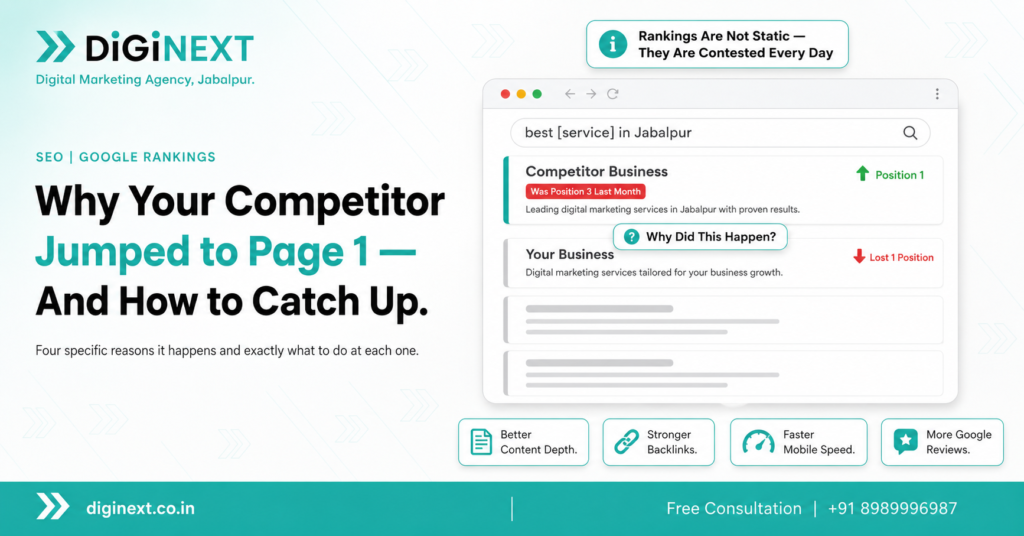
Google ranks pages based on three core factors: relevance, authority, and user experience signals. When a competitor overtakes your position, they have improved on at least one of these dimensions more recently than you have. Rankings are not static snapshots; they are updated continuously as new content is published, new links are earned, and ongoing user behaviour data is processed.
Google compares every page competing for the same keyword against each other on a continuous basis. When a competitor publishes better content, earns stronger backlinks, or improves their technical setup, they accumulate more positive ranking signals than they had before. If your page has stayed unchanged while theirs has improved, the gap between your positions closes and eventually flips.
The critical thing to understand is that Google does not punish your page for staying the same. It rewards the page that improved more recently. Inaction in an active competitive environment produces the same result as decline.
The Specific Reasons a Competitor Overtakes You
Most ranking shifts have one of four causes and identifying which one drove the change in your situation is the starting point for a response.
They published more comprehensive content on the same topic. Google measures how completely a page answers the searcher’s query by tracking engagement signals. A page that keeps users reading longer, prompts them to click through to related pages, and satisfies the search intent without sending users back to Google to find a better answer will outrank a shallower page on the same topic over time. If their blog post or service page covers the topic more completely than yours, that is the most likely reason they moved above you.
They earned new backlinks from credible sources. A single strong link from a credible local news article, an industry directory, or a relevant partner website can shift a page’s position more than months of on-page optimisation. Backlinks remain one of Google’s strongest authority signals, and a competitor who earned a meaningful link recently may have tipped the balance in their favour on competitive keywords.
Their technical performance improved. Google directly weights page speed and Core Web Vitals performance in its ranking algorithm. A competitor whose mobile page speed score improved significantly, whose site moved to faster hosting, or who fixed technical crawl issues will see ranking benefits within weeks of those changes. If their page loads in two seconds on mobile and yours loads in seven, that gap is a ranking factor working against you every single day.
Their local review profile strengthened significantly. For local search specifically, review count, average rating, and recency of reviews are direct local ranking signals. A competitor who went from 25 to 90 Google reviews in the last three months has built a significantly stronger local authority signal. Google’s local algorithm interprets that volume of recent positive feedback as evidence of an active, trusted, community-endorsed business and rewards it with higher local visibility.
How to Find Out Exactly What Changed
Before responding, find out specifically which of these causes drove the shift. Guessing the wrong cause and fixing the wrong thing produces no ranking recovery.
Open their ranking page and run three checks. First, read their content carefully. Is it longer, more structured, or more complete than what you are currently ranking with? Does it cover questions yours does not? Does it include more specific examples, proof points, or actionable information? If yes, the content gap is likely the primary cause.
Second, check their Google Business Profile. How many reviews do they have today compared to three months ago? If the number jumped significantly, that is almost certainly contributing to their local ranking improvement. Your Google Business Profile review count relative to theirs tells you whether the local authority gap is part of the problem.
Third, run both your page and their page through Google PageSpeed Insights and compare the mobile scores specifically. Google uses mobile-first indexing, so the mobile score is what matters most. A gap of more than 20 points between their score and yours is significant enough to be a ranking factor.
These three checks take about thirty minutes and in most cases identify the primary cause without needing any paid tools. If you want a full SEO audit beyond these three checks, our SEO services page covers what a proper audit involves.
The Actions That Start Closing the Gap Fastest
Once you know what changed, the response becomes specific rather than guesswork.
If the cause is content depth: Update the page that lost its position. Not a complete rewrite, but a meaningful expansion. If their version covers five subtopics and yours covers three, add the missing two with genuine depth and specific information. If their FAQ section has eight questions and yours has four, add four more that your customers actually ask. Do not add content to hit a word count. Add content that makes the page more complete and more useful than the competing version. Google’s system re-evaluates updated pages relatively quickly, and a meaningful content improvement typically produces ranking movement within four to eight weeks.
If the cause is page speed: Fix the technical gap. Compress all images on the page, switch to a caching plugin if the site is on WordPress, and check whether the hosting plan is under-resourced for the traffic level. These changes are not glamorous but they produce measurable ranking movement because they directly address a factor Google measures and weights. A page that goes from a mobile PageSpeed score of 35 to 75 after technical fixes will see ranking benefit from that change within weeks.
If the cause is the review gap: Start a systematic review collection process immediately. Identify the last ten customers who had a positive experience and send each one the direct link to your Google Business Profile review page on WhatsApp. Make it take thirty seconds for them to leave a review. Do this every week with every new satisfied customer going forward. Review gaps that look daunting close faster than most business owners expect when the process is systematic and consistent.
If backlinks are the cause: This is the most time-consuming gap to close because earning quality backlinks takes time and cannot be manufactured quickly. Start by identifying what specifically earned them the new link. Was it a news mention? A directory listing? A partnership? Then identify the equivalent opportunity in your own network and pursue it. A link from a local Jabalpur news outlet, an industry association listing, or a collaboration with a complementary business in your city all generate the kind of local link authority that helps close this gap.
Why Staying on Page 1 Requires Ongoing Work, Not a One-Time Fix
Here is what most small business owners do not factor in when they achieve a good ranking. The position is not owned. It is occupied temporarily and continuously contested. Every competitor in your category who is actively working on their SEO is working to take that position from you, whether or not they are aware of yours specifically.
A page that ranked well eighteen months ago and has not been updated since is living on borrowed time. As competitors publish fresher content, earn new links, and improve their technical setup, the page that was ahead gradually falls behind. This is not a sudden dramatic drop. It is a slow, consistent erosion that often goes unnoticed until a competitor has already moved above.
The best SEO agency in Jabalpur for your business is not the one that gets you to Page 1 once. It is the one that treats staying on Page 1 as an ongoing effort, monitors competitor activity regularly, and responds to ranking shifts before they become large gaps. Reach out to DigiNext at 8989996987 or visit our contact page to understand what ongoing SEO management looks like and what it costs for a local business in Jabalpur.
Frequently Asked Questions
1. How long does it take to recover rankings after a competitor overtakes you?
Recovery timeline depends on what changed and how quickly you respond. A content improvement on your page combined with faster load speed can produce visible ranking movement within four to eight weeks in most cases. A significant backlink gap takes longer to close because earning quality links requires time regardless of how good the content is. Most businesses that respond correctly within the first month of noticing a ranking shift recover to their previous position within three to four months of consistent work.
2. Can a Google algorithm update cause a competitor to suddenly jump above me without them doing anything new?
Yes. Google’s core algorithm updates, which happen several times per year, recalibrate how different signals are weighted across the entire ranking system. A competitor whose content was always more comprehensive than yours may suddenly rank above you after an update that increases the weight of content quality relative to technical signals. These updates tend to accelerate the gap between pages that have been consistently building authority and those that have relied on older signals without maintaining quality.
3. What is the single fastest action I can take to start recovering a lost position?
Update the actual content on the page that lost its position. This does not mean a complete rewrite. It means meaningfully improving the depth, structure, and completeness of the existing content. A genuine content improvement signals to Google that the page has been updated, which triggers a re-evaluation of its position relative to competing pages. Pair this with image compression to improve mobile load speed and the combined effect typically becomes visible in search rankings within four to six weeks.
4. Should I be monitoring competitor rankings proactively or only respond when they move above me?
Proactive monitoring is significantly more effective than reactive response. Catching a competitor climbing from Position 5 to Position 3 allows you to respond before they reach Position 1. Catching them only after they have already moved above you means starting from a more disadvantaged position. Google Search Console shows your own average position for each keyword. A simple monthly manual search check of your five most important keywords shows whether competitor positions are shifting. Free tools like Ubersuggest also allow basic competitor position tracking.