

Backlinks Still Matter in 2026: Here is What Actually Counts Now
Every business owner who has spent time researching SEO has encountered the same advice: get more backlinks. For years, backlinks were treated as the single most important ranking factor in Google’s algorithm. More links meant higher rankings. The more the better, regardless of where they came from.
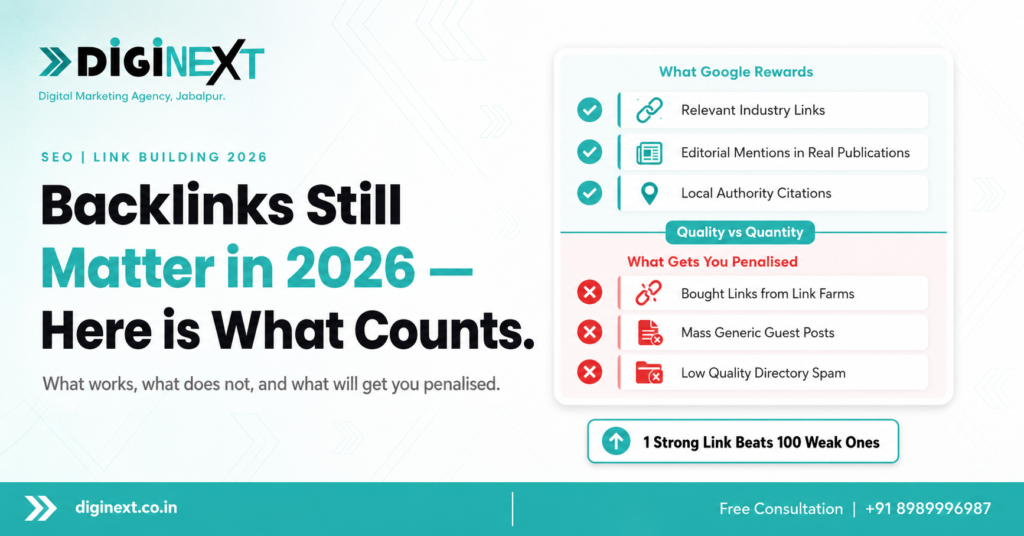
That era is over. Backlinks in 2026 still matter enormously, but the way Google evaluates them has become significantly more sophisticated. A hundred low-quality links from irrelevant websites will not help your rankings. In many cases they will actively hurt them. Meanwhile a single well-placed link from a genuinely authoritative and relevant source can move your rankings more than fifty mediocre ones.
Here is what actually counts now and what you need to stop doing immediately.
Why Backlinks Still Matter Despite Everything Google Has Changed
Google’s algorithm has gone through hundreds of updates since backlinks were first used as a ranking signal. Helpful Content Updates, Core Updates, spam policy changes. Through all of it, backlinks have remained a core part of how Google determines the authority and trustworthiness of a page.
The reason is fundamental. A backlink is essentially a vote of confidence from one website to another. When a genuinely respected website links to your content, it is telling Google that your page is worth referencing. Google interprets that signal as evidence of credibility. A page with strong, relevant backlinks from authoritative sources consistently outranks a page with similar content but no external links pointing to it.
What has changed is Google’s ability to distinguish between genuine editorial links earned on merit and artificial links built purely to manipulate rankings. In 2026, that distinction is where everything lives.
What Google Actually Values in a Backlink Today
Not all backlinks carry the same weight. These are the specific characteristics that determine whether a link helps your rankings or does nothing at all.
Relevance is the first filter. A link from a website in a related industry or topic area carries significantly more weight than a link from an unrelated site, even if that unrelated site has higher overall authority. A local news article about a Jabalpur furniture business linking to your furniture website is more valuable than a link from a high-authority international technology blog that has no connection to your industry. Google’s algorithm understands topical context and rewards links that make sense within it.
Genuine authority matters more than domain rating numbers. Domain Rating and Domain Authority are third-party metrics, not Google metrics. A website with a modest DA score that is genuinely well-regarded in its specific niche can pass more real ranking value than a high-DA website that publishes generic content across dozens of unrelated topics. The question to ask about any potential link source is: does this website have a real audience that trusts it? If yes, a link from there has value. If it is a site that exists primarily to sell links, the answer is no regardless of its metrics.
Editorial context is everything. A link that is placed naturally within the body of an article, where a writer genuinely references your content as a useful source, carries far more weight than a link dropped in a footer, sidebar, or links directory page. Google’s algorithms are built to identify editorial intent. Links that appear because someone found your content genuinely useful look fundamentally different in the algorithm’s eyes than links that were placed artificially.
What No Longer Works and What Will Get You Penalised
This is the section that most SEO guides either skip or soften. Here is the direct version.
Buying links from link farms, private blog networks, or link-selling services is explicitly against Google’s spam policies and has been for years. In 2026, Google’s ability to identify these patterns is significantly better than it was even three years ago. A manual spam action from Google for unnatural link building can cause a sharp ranking drop that takes months to recover from. The short-term rankings boost that bought links sometimes produce is almost never worth the risk.
Guest posting purely for links has also lost most of its value. The practice of writing generic articles for low-quality websites solely to include a backlink to your site is something Google specifically identifies and discounts. Guest posting on genuinely relevant, high-quality publications that have real editorial standards still has value. Mass guest posting across dozens of weak sites does not.
Directory submissions to generic, low-quality web directories contribute almost nothing to rankings in 2026. The exception is authoritative industry-specific directories and local business listings on platforms like Google Business Profile, Justdial, Sulekha, and similar sites that carry genuine local relevance for Indian businesses.
What Link Building Actually Looks Like in 2026
The most effective link building strategy in 2026 is creating content that earns links rather than chasing them. This sounds vague until you look at what it means in practice.
Content that earns links is content that other websites want to reference because it is genuinely useful, contains original information, or answers a question better than anything else available. A detailed local business guide, an original study about your industry, a resource page that aggregates genuinely useful tools, or a well-researched blog that gets cited by other writers in the space. These are the content types that attract editorial backlinks naturally over time.
Digital PR is another approach that works well for local businesses. Getting mentioned in local news outlets, industry publications, or business directories through genuine news, awards, community involvement, or expert commentary generates exactly the kind of authoritative, contextual links that Google rewards. A mention in a credible local publication about a Jabalpur business is worth more for local SEO than ten links from generic blogging websites.
Building relationships with complementary businesses and getting genuine referral mentions on their websites is a third approach that is underused by most small businesses. A collaboration, a co-authored article, or a mutual recommendation between two non-competing businesses that serve the same audience can produce links that are both high-quality and highly relevant.
Real Questions Business Owners Ask About Backlinks
1. How many backlinks does a small local business actually need to rank well?
For local search in a city like Jabalpur, you typically need fewer high-quality backlinks than you might think. Competing nationally or globally requires significant link authority built over years. Competing locally for service-area keywords often requires a handful of genuinely strong local and industry-relevant backlinks combined with solid on-page SEO and a well-maintained Google Business Profile. Quality consistently outperforms quantity in local SEO link building.
2. How do I check what backlinks my website currently has?
Free tools like Google Search Console show you which websites are linking to yours under the Links report. For a more comprehensive view, tools like Ahrefs, Semrush, or the free version of Moz show your backlink profile including the quality and relevance of linking sites. Running this audit tells you whether your current links are helping your rankings or whether you have toxic links that need to be addressed.
3. What should I do if my website has a lot of low-quality or spammy backlinks?
Google’s algorithm ignores most low-quality links rather than penalising them automatically. However, if your site has a history of aggressive link building with clearly artificial links, submitting a disavow file through Google Search Console tells Google to ignore those specific links when evaluating your site. This should be done carefully and only when there is clear evidence of harmful links. Disavowing legitimate links by mistake can hurt rankings. If you are unsure, a professional SEO audit will identify which links need attention.
4. Does my Google Business Profile count as a backlink to my website?
A link from your Google Business Profile to your website is a citation signal rather than a traditional backlink, but it absolutely contributes to your local search authority. More importantly, consistent NAP data, which means your business name, address, and phone number appearing identically across Google Business Profile, your website, and all local directories, is a foundational local SEO signal that directly affects how Google ranks your business in local search results.
5. Is link building still worth investing in for a local business or should the focus be entirely on content?
Both matter and they work best together. Content without links takes longer to rank because it has no external authority signals supporting it. Links without quality content point to pages that do not satisfy user intent, which limits how high they can actually rank regardless of the link authority behind them. For local businesses, the most efficient approach is to create genuinely useful content and pursue a small number of high-quality, relevant local links rather than chasing volume.
Build Links That Earn Their Place
Backlinks in 2026 are not about quantity. They are not about domain authority scores. They are about whether a real, relevant, trusted source found your content useful enough to reference. That is the standard Google is measuring against, and it is the standard your link building strategy needs to meet.
The businesses that build sustainable SEO authority are the ones creating content worth linking to and earning mentions from sources that genuinely matter in their space. Everything else is either irrelevant or a risk.