
Introduction
Something significant has shifted in how people find businesses online. A growing number of your potential customers are no longer typing queries into Google and scrolling through blue links. They are asking ChatGPT, using Perplexity, or getting an AI-generated summary at the top of their Google results that answers their question before they ever click on anything.
This is called AI search, and it is changing what it means to be visible online. If your content strategy is built entirely around traditional Google rankings, you are already missing a portion of the audience that is looking for exactly what you offer. Here is what AI search actually is, why it matters for local businesses, and what you need to do to show up in it.
What AI Search Is and Why It Is Different From Traditional SEO
Traditional SEO gets your website ranked on Page 1 of Google. When someone clicks your result, they visit your website. That is the model most businesses have been optimising for since the early 2000s.
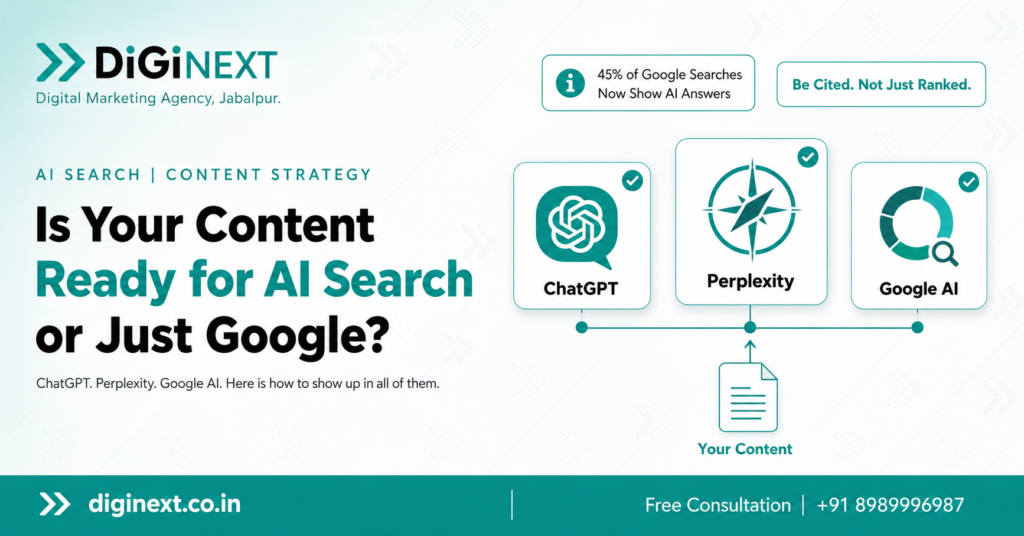
AI search works differently. When someone asks ChatGPT “What is the best digital marketing agency in Jabalpur?” or asks Perplexity “How long does SEO take to work?” The AI does not show them a list of links to scroll through. It reads multiple sources, synthesises the information, and delivers a direct answer. Sometimes it cites the sources it used. Sometimes it does not.
The critical difference is this: in traditional SEO you need to rank. In AI search you need to be cited. A well-structured page can get cited by an AI system even if it ranks on Page 2 or Page 3 of Google, because AI systems select sources based on content quality, structure, and authority rather than purely on rank position.
Google AI Overviews alone now appear in roughly 45% of all Google searches. That means nearly half the time someone searches something on Google, they see an AI-generated answer before they see any organic results. For informational queries, how-to questions, and comparison searches, that number is even higher.
Why Most Business Content Gets Ignored by AI Systems
AI systems do not read content the way humans do. They extract information from it. And content that is not structured for extraction gets passed over, even if it is well-written and ranks well in traditional search.
Here is what AI systems are looking for when they decide whether to cite a source:
Direct answers placed early. An AI system scanning your blog for an answer to “how long does SEO take” needs to find that answer quickly and clearly. If your first three paragraphs are an extended introduction before you get to the point, the AI moves on to a source that answers the question in the first paragraph.
Self-contained answer blocks. Each section of your content should work as a standalone answer. An AI does not always pull a full article. It extracts a passage of forty to sixty words that directly answers a specific query. If your paragraphs only make sense in the context of everything around them, they are not extractable.
Specific numbers and statistics. Vague claims like “SEO takes some time” are never cited. Specific claims like “most businesses see meaningful ranking movement within three to six months” give AI systems something concrete to extract and attribute. Research from Princeton’s GEO study shows that adding statistics to AI increases visibility by up to 37%
Questions as headings. AI systems match user queries to content headings. A heading that reads “How Long Does SEO Take” is far more likely to be matched to a user asking that question than a heading that reads “The SEO Timeline Explained”.
The Three Things Your Content Needs to Be AI-Ready
Getting cited by AI systems consistently comes down to three things: structure, authority, and presence.
Structure means making your content extractable. Every major section should open with a direct answer to the question that section addresses. Use numbered lists for process content. Use comparison tables for versus queries. Keep your most important answer in the first forty to sixty words of each section. Write headings that match how people actually phrase questions, not how you would title a chapter in a book.
Authority means giving AI systems a reason to trust your source. This includes citing external sources when you make specific claims, attributing expert opinions with names and credentials, updating content regularly and showing the last-updated date visibly on the page, and building your business’s presence on third-party platforms like Google Business Profile, industry directories, and review sites. Research shows that brands are 6.5 times more likely to be cited by AI systems via third-party sources than from their own website alone.
Presence means being in places AI systems look. Your website is one source. But AI systems also pull from Google Business Profile data, review platforms, local directories, news articles, and Wikipedia. A business that has consistent, accurate, detailed information across all of these sources appears more authoritative to AI systems than a business that only exists on its own website.
What This Means Practically for a Business in Jabalpur
For a local business in Jabalpur, the immediate opportunity in AI search is significant. Most local competitors have not thought about this at all. Their content is structured for human readers at best and for keyword density at worst. Neither of those approaches gets cited by AI.
Here are the specific changes that make the biggest difference for local businesses right now:
Rewrite your service pages so the first paragraph clearly defines what you do, who you do it for, and where you operate. A page that opens with “DigiNext is a digital marketing agency in Jabalpur offering SEO, social media marketing, and web development services to local businesses” gives an AI system everything it needs to cite you when someone asks, “Who are the best digital marketing agencies in Jabalpur?”
Add a proper FAQ section to every service page and blog post. FAQ sections are among the most consistently cited content formats across all AI platforms. Each question should be phrased the way a real person would ask it and the answer should be complete and self-contained in two to four sentences.
Build your presence on Google Business Profile completely and keep it updated. ChatGPT, Perplexity, and Google AI Overviews all draw on Google’s knowledge graph when answering local business queries. A fully built, regularly updated Google Business Profile with consistent reviews is a direct AI search visibility signal.
Make sure AI crawlers can access your website. Each major AI platform has its own web crawler: GPTBot for ChatGPT, PerplexityBot for Perplexity, ClaudeBot for Claude, and Google-Extended for Google’s AI systems. If any of these are blocked in your website’s robots.txt file, that platform cannot cite you regardless of how good your content is.
Traditional SEO and AI SEO Are Not Separate Strategies
This is the most important point to understand clearly. You do not need to abandon your traditional SEO strategy and replace it with an AI search strategy. The fundamentals overlap significantly.
Good traditional SEO requires quality content, clear structure, authoritative sources, and strong technical foundations. Good AI SEO requires exactly the same things, with additional attention to answer-first formatting, extractable content blocks, and third-party presence. A business that does both well is building a content foundation that performs in traditional search, in AI overviews, in ChatGPT, in Perplexity, and in every search format that emerges after them.
The businesses that will dominate local search in Jabalpur over the next three years are the ones that start building AI-ready content now, while most of their competitors are still thinking about SEO the way they did in 2019.
Real Questions Business Owners Ask About AI Search
1. Do I need to completely rewrite all my existing content for AI search?
Not necessarily. Start by auditing your most important pages: your homepage, your core service pages, and your top-performing blog posts. For each one, check whether the first paragraph directly answers the most likely user query, whether each section has a clear extractable answer, and whether there is a proper FAQ section. In many cases these are additions and restructuring rather than full rewrites. New content should be written with AI search in mind from the start.
2. How do I know if my business is currently being cited in AI search results? The simplest way is to test it manually. Open ChatGPT, Perplexity, and Google with your most important search queries, such as your service plus your city, and see whether your business appears in the answers. Do this monthly and track whether your presence is growing or whether competitors are consistently appearing where you are not. Paid tools like Peec AI and Otterly offer automated monitoring across multiple AI platforms if you want a more systematic approach.
3. Does local SEO still matter if AI search is growing?
Absolutely. Local SEO and AI search optimisation work together. Google AI Overviews for local queries pull heavily from Google Business Profile data, local search rankings, and review signals. A business with strong local SEO has a significant head start in local AI search visibility. The two strategies reinforce each other rather than compete.
4. Will AI search eventually replace traditional Google search completely?
Not entirely, at least not in the near term. Traditional link-based search results still appear alongside AI overviews, and many users still prefer clicking through to websites for detailed information. What is changing is the proportion. AI overviews now appear in roughly 45 per cent of searches, and that number is growing. The businesses that prepare now will be positioned well regardless of how the balance shifts over the next few years.
5. What is the single most important change a local business can make for AI search right now? Restructure your most important pages so every section opens with a direct, specific answer to the question it addresses. This single change improves both traditional SEO snippet performance and AI search extractability simultaneously. It costs nothing except time and has a measurable impact on how often your content gets surfaced across all search platforms.
The Businesses That Act Now Will Have the Advantage
AI search is not a future trend to monitor. It is a current reality affecting how your potential customers find businesses right now. The gap between businesses that have optimised for it and those that have not will only widen from here.
The good news for local businesses in Jabalpur is that the competition in AI search at a local level is still very early. Most local businesses have not started thinking about this yet. Getting your content structured properly, your authority signals built, and your third-party presence established now puts you significantly ahead of competitors who will eventually have to catch up.
If you want a proper audit of how your current content performs in both traditional and AI search, and a clear plan to improve your visibility across both, reach out to DigiNext at 8989996987. The team will assess where you stand today and build a content strategy that works for every search platform your customers are using.

1 Comment
very nice blog and whole information in this about google new update