

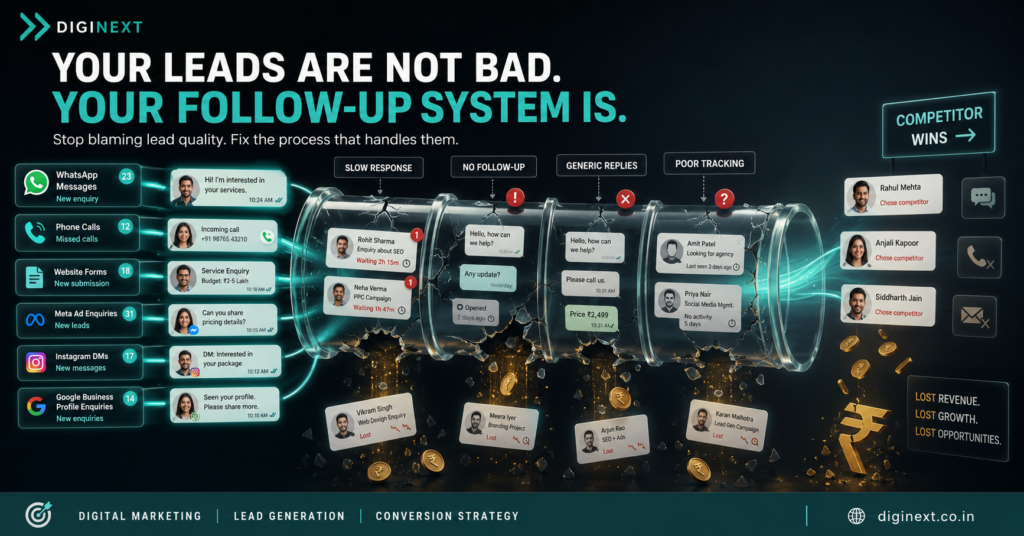
Introduction
Most businesses believe they have a lead-generation problem.
“The leads are not serious.”
“The audience is wrong.”
“Digital marketing does not work.”
“The agency is sending low-quality leads.”
Sometimes lead quality is genuinely poor. But in many cases, the bigger problem is not the lead. It is what happens after the lead arrives.
A potential customer may be interested when they submit an enquiry. But interest has a limited lifespan. If the response is slow, generic, confusing, or overly aggressive, that interest disappears.
Your marketing may be generating opportunities correctly. Your follow-up system may be losing them.
The Lead Is Only the Beginning
A lead is not a sale. It is simply a person who has shown some level of interest in your product or service.
They may have:
- Filled out a Meta advertisement form
- Sent a message on WhatsApp
- Called your business
- Submitted a website enquiry
- Asked for the price on Instagram
- Requested more information through Google Business Profile
At this stage, the customer has not committed to purchasing. They are still comparing, evaluating, and trying to understand whether your business is the right choice.
The role of follow-up is to move the customer from curiosity to confidence.
Without a structured follow-up process, even a good lead can become a lost opportunity.
Slow Responses Kill Buying Intent
When people enquire about a service, they usually do not contact only one business.
A customer looking for a gym, hospital, coaching institute, salon, car detailing studio, marketing agency, or interior designer may contact three or four providers within a few minutes.
The business that responds first does not automatically win. But it gains an immediate advantage.
A quick response shows that the business is active, organised, and interested in helping.
A delayed response creates doubt.
When a business replies after several hours, the customer may have already spoken to a competitor, received a quotation, booked an appointment, or mentally moved on.
Businesses often focus heavily on advertisement design and targeting while ignoring response speed. But fast follow-up is one of the simplest ways to improve conversion without increasing the advertising budget.
Generic WhatsApp Replies Do Not Build Trust
Many businesses respond to every enquiry with the same message:
“Hello, how can we help you?”
“Please call us.”
“Visit our office for details.”
“Price starts from ₹____.”
These replies provide information, but they do not create a meaningful conversation.
The customer expects the business to understand why they enquired. A better response refers to the specific service, asks one relevant question, and gives the customer a clear next step.
For example, instead of writing:
“Car polishing available. Contact us.”
A car detailing business could write:
“Thank you for enquiring about car polishing. Which car model do you have, and are you mainly concerned about scratches, dull paint, or overall shine? Based on that, we can recommend the right treatment.”
This response does three things:
It confirms the service, identifies the customer’s concern, and moves the conversation forward.
The goal of the first reply is not to close the sale immediately. It is to get the customer to respond again.
Your Team May Be Sharing Prices Without Selling Value
Customers frequently ask one direct question:
“What is the price?”
Many sales teams answer with only a number.
When price is presented without context, the customer has no reason to understand why the service costs that amount. The conversation becomes a comparison between numbers rather than value.
This is especially damaging for businesses offering professional, customised, premium, or trust-based services.
Before sharing the price, the sales representative should understand:
- What the customer needs
- What problem they are trying to solve
- How urgent the requirement is
- What result they expect
- Whether they have used a similar service before
Once the requirement is clear, the price can be connected to the outcome.
For example:
“Our interior cleaning package starts from ₹2,499. It includes deep vacuuming, seat cleaning, dashboard treatment, floor cleaning, and odour removal. The final price depends on the vehicle size and interior condition.”
This gives the customer something meaningful to evaluate.
One Follow-Up Is Usually Not Enough
Many businesses contact a lead once and stop.
They send a quotation, make one phone call, or share a brochure. If the customer does not reply, the lead is marked as uninterested.
But silence does not always mean rejection.
The customer may be busy. They may be discussing the decision with family members. They may be waiting for their salary. They may have forgotten to reply. They may still be comparing options.
A proper follow-up system should include multiple contact points without becoming irritating.
A simple sequence could be:
Day 1: Respond to the enquiry and understand the requirement.
Day 2: Share relevant details, pricing, examples, or testimonials.
Day 4: Ask whether the customer needs clarification.
Day 7: Share a practical reason to act, such as limited availability, an upcoming batch, appointment slots, or a valid offer.
Day 14: Send a final polite follow-up and keep the contact available for future nurturing.
The follow-up should add value each time. Repeatedly writing “Any update?” is not a strategy.
Poor Lead Tracking Creates Invisible Revenue Loss
When leads are managed through personal WhatsApp chats, notebooks, call logs, and memory, follow-ups become inconsistent.
Some leads receive several calls. Others are forgotten completely.
The business owner may believe the campaign is not working because sales are low. In reality, nobody knows:
- How many leads were contacted
- How quickly they were contacted
- How many replied
- How many received quotations
- How many follow-ups were completed
- Why prospects did not purchase
- Which salesperson converted the most leads
Without tracking, businesses cannot identify where the sales process is breaking.
Even a basic spreadsheet can improve accountability. It should record the customer’s name, contact details, enquiry source, service interest, lead status, last contact date, next follow-up date, and final outcome.
Larger teams can use a customer relationship management system, but the principle remains the same.
Every lead should have a clearly defined next action.
Marketing and Sales Must Work Together
Businesses often treat marketing and sales as separate departments.
Marketing is expected to generate leads. Sales is expected to close them.
When sales are low, both sides blame each other.
Marketing says the sales team is not following up properly.
Sales says the leads are not qualified.
The solution is not blame. It is feedback.
The sales team should regularly report:
- Which leads were irrelevant
- Which services received the most interest
- What objections customers raised
- Which locations generated better enquiries
- What price concerns appeared repeatedly
- Which advertisements attracted high-intent customers
This information helps the marketing team improve targeting, messaging, offers, and campaign structure.
At the same time, the marketing team should ensure that advertisements set correct expectations. Misleading offers and vague claims may generate more leads, but they often produce lower conversion rates.
Good marketing attracts the right conversation. Good follow-up turns that conversation into revenue.
Build a Follow-Up System, Not Individual Heroics
A business should not depend on one talented salesperson who remembers every lead.
The process must work consistently, regardless of who handles the enquiry.
A practical follow-up system should define:
Response Time
Set a maximum response time for new enquiries. During business hours, the team should ideally respond within a few minutes rather than several hours.
First Response Template
Create templates for common services, but personalise them according to the enquiry. Templates should support the conversation, not make it robotic.
Qualification Questions
Decide which questions help identify customer needs, budget, urgency, location, and suitability.
Lead Stages
Use clear stages such as new enquiry, contacted, qualified, quotation shared, follow-up required, converted, lost, and future prospect.
Follow-Up Schedule
Define when the team should call or message again. Do not leave follow-up timing to memory.
Performance Review
Review lead data weekly. Identify response delays, missed follow-ups, common objections, and conversion rates.
Stop Blaming Leads Before Auditing the Process
It is easy to blame the advertisement platform, agency, salesperson, economy, or customer.
But before increasing the budget or changing the campaign, examine the full lead journey.
Check how quickly enquiries are answered.
Read the actual WhatsApp conversations.
Listen to sales calls.
Review whether the team asks useful questions.
Check whether quotations explain value.
Measure how many follow-ups happen before a lead is abandoned.
You may discover that the business does not need more leads.
It needs to handle the existing leads properly.
Conclusion
Lead generation creates attention. Follow-up converts that attention into business.
A strong advertising campaign cannot compensate for slow replies, generic messages, unclear pricing, poor tracking, and inconsistent communication.
The most profitable improvement may not be a larger marketing budget. It may be a better system for responding to the opportunities you already receive.
Before calling your leads weak, examine your process.
Your leads may not be bad.
Your follow-up system may be.
Frequently Asked Questions
1. How quickly should a business respond to a new lead?
A business should respond as quickly as possible during working hours. The longer the delay, the greater the chance that the prospect will contact or choose a competitor.
2. How many times should a sales team follow up?
There is no universal number, but one follow-up is rarely sufficient. A structured sequence of four to six value-based follow-ups is more effective than repeatedly asking for an update.
3. Should businesses use automated WhatsApp replies?
Automated replies can confirm that the enquiry has been received, but they should not replace personalised communication. A team member should continue the conversation with relevant questions.
4. Why do customers ask for the price and then stop replying?
Customers may not understand the value, may be comparing providers, or may not be ready to purchase. Sharing only the price without explaining the outcome, process, or inclusions often weakens the conversation.
5. How can a business improve its lead conversion rate?
Improve response speed, qualify prospects, personalise communication, explain value clearly, track every lead, schedule follow-ups, and review lost-lead reasons regularly.
Turn More Enquiries Into Customers
Generating leads is only half the job. Your response process, sales communication, and follow-up structure determine whether those leads produce revenue.
Contact DigiNext to build a marketing system that does not stop after generating the enquiry.