
Introduction
AI is not the problem. Lazy execution is. A good marketing agency uses AI to research faster, sharpen ideas, improve workflows, and test more angles. A lazy agency uses AI to produce generic content, weak designs, recycled captions, and surface-level strategies that look busy but deliver very little.
This matters because AI is now common in marketing. HubSpot’s 2026 State of Marketing report says 80% of marketers use AI for content creation and 75% use it for media production. That means the real question is no longer, “Is my agency using AI?” The better question is, “Are they using it intelligently?”
Google has also made its position clear. AI-generated content is not automatically bad. What matters is whether the content is helpful, reliable, and created for people, not just produced to manipulate rankings.
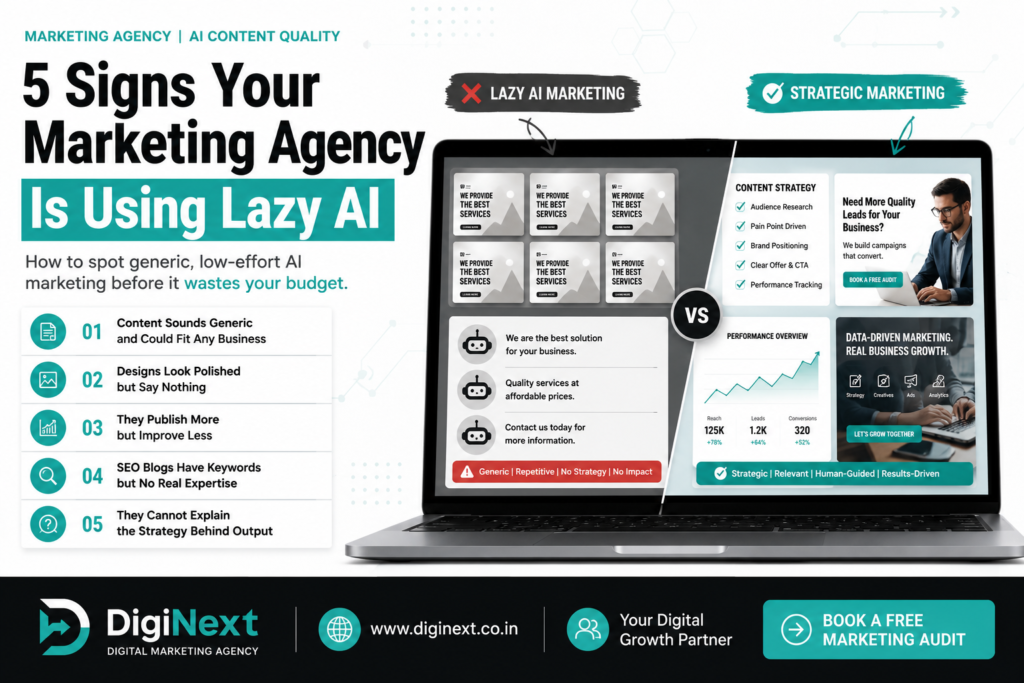
So here are five clear signs your marketing agency is using lazy AI.
1. Their Content Sounds Generic and Could Fit Any Business
This is the first and most obvious sign.
If your captions, blogs, ads, and website content sound like they could belong to any business in any city, your agency is probably using AI lazily.
Lazy AI content usually sounds like this:
“Looking for the best service provider? We offer quality solutions at affordable prices. Contact us today for the best experience.”
That kind of writing says nothing. It has no market insight, no local context, no customer pain point, no proof, and no brand personality.
A serious agency will use AI only as a support tool. The final content should include your actual services, your target audience, your location, your offers, your objections, and your business positioning.
For example, a lazy agency writes:
“Get the best dental care for your family.”
A sharper agency writes:
“Searching for a family dentist in Jabalpur? Here is what you should check before choosing a clinic for braces, root canal, kids’ dentistry, or emergency dental care.”
See the difference? One is filler. The other is useful.
2. Their Designs Look Polished but Say Nothing
AI can now create beautiful images, posters, thumbnails, and ad creatives. But beauty without strategy is decoration.
A lazy AI agency will show you designs that look modern, colourful, and “premium,” but the creative will not answer the most important marketing questions:
Who is this for?
What is the offer?
Why should the customer care?
What action should they take?
What makes this business different?
This is common in social media posters. The design looks attractive, but the message is weak. No urgency. No hook. No conversion angle. No local relevance. No reason to stop scrolling.
A good agency does not start with tools. It starts with the customer’s problem.
For example, for a gym, lazy AI gives:
“Transform your body today.”
Better marketing gives:
“First time joining a gym? Get trainer-guided workouts so you do not waste your first 30 days doing random exercises.”
The second one works because it speaks to a real fear: beginners do not know what to do inside the gym.
That is marketing. The first one is noise.
3. They Publish More but Improve Less
Lazy AI makes agencies faster. That is not always a good thing.
If your agency is suddenly posting a lot more content but your leads, enquiries, reach, ranking, or engagement are not improving, there is a problem.
More content is not automatically better content.
A weak agency uses AI to increase volume. A strong agency uses AI to improve direction.
You should not judge your agency only by how many posts they publish. Judge them by whether they are improving these things:
Search visibility
Website traffic quality
Google Business Profile actions
Ad enquiry cost
Content engagement
Lead quality
Conversion rate
Brand recall
Content Marketing Institute’s 2025 B2B report shows that marketers are investing in formats like video, thought leadership, AI optimisation, paid advertising, and AI content creation. The important point is that serious marketers are not just creating more. They are investing in formats and systems that improve performance.
So ask your agency one hard question:
“What changed because of this content?”
If they cannot answer with data, they are probably just feeding the content machine.
4. Their SEO Blogs Have Keywords but No Real Expertise
This is one of the most dangerous forms of lazy AI.
Many agencies now generate SEO blogs in minutes. They add keywords, headings, FAQs, and meta descriptions. On paper, it looks like SEO work. In reality, the blog may be empty.
Lazy AI blogs usually have these problems:
They repeat the same point again and again.
They give obvious advice.
They do not include examples.
They do not answer local search intent.
They do not explain pricing, process, comparison, risks, or decision factors.
They do not show real experience.
Google’s people-first content guidance focuses on usefulness, reliability, and original value. That means a blog should help the reader make a better decision, not just exist because a keyword has search volume.
For example, a lazy SEO blog on “best digital marketing agency in Jabalpur” will say:
“Choose an experienced agency with good services and affordable pricing.”
That is useless.
A better blog will explain:
How to compare SEO agencies in Jabalpur
What questions to ask before hiring
What monthly reports should include
What red flags to avoid
Why cheap SEO packages usually fail
How long local SEO realistically takes
What results a business should expect in 3, 6, and 12 months
That kind of content builds trust. It also has a better chance of ranking because it actually solves the searcher’s problem.
5. They Cannot Explain the Strategy Behind the Output
This is the biggest red flag.
When you ask your agency why they made a certain post, ad, blog, or design, they should be able to explain the thinking behind it.
Not vague answers like:
“Sir, this is trending.”
“AI suggested this.”
“This type of content performs well.”
“We are maintaining consistency.”
These are weak answers.
A proper agency should explain:
The target audience
The customer pain point
The campaign objective
The platform logic
The creative hook
The offer angle
The expected action
The metric being tracked
The next optimisation step
AI can help generate options. It cannot replace strategic accountability.
This is also where false AI claims become risky. The FTC has acted against deceptive AI-related marketing claims, especially when businesses exaggerate what AI systems or AI-powered offers can do. The lesson is simple: agencies should not hide behind AI buzzwords. They must be able to prove the logic and outcome of their work.
If your agency cannot explain the strategy, they are not doing marketing. They are producing assets.
There is a difference.
Lazy AI vs Smart AI: What Is the Difference?
Lazy AI means:
Generic prompts
Generic content
No customer research
No brand voice
No proofreading
No human judgement
No performance review
No strategy behind output
Smart AI means:
Faster research
Better content briefs
Sharper hooks
Multiple creative angles
SEO-supported structure
Clear audience mapping
Human editing
Data-backed improvement
Brand-specific execution
The tool is not the differentiator. The thinking is.
A weak marketer with AI becomes faster at producing weak work.
A strong marketer with AI becomes faster at testing, improving, and scaling what already makes sense.
That is the real difference.
What Business Owners Should Ask Their Agency
Before approving another month of content, ask these questions:
Why are we creating this content?
Which audience problem does it solve?
Which keyword or campaign goal does it support?
What result are we tracking?
What did we learn from last month’s performance?
What are we changing this month?
If your agency answers clearly, good. If they avoid the question, use buzzwords, or send another colourful report with no interpretation, you have your answer.
Conclusion: AI Should Make Marketing Sharper, Not Lazier
AI is not killing marketing. Lazy marketers are.
The best agencies are not scared of AI. They use it to move faster, think wider, test better, and deliver sharper work. But they still bring strategy, judgement, brand understanding, customer insight, and accountability.
If your agency is only giving you generic posts, empty blogs, over-designed creatives, and vague monthly reports, they are not using AI properly.
They are using AI to look busy.
And busy does not grow your business.
If you want marketing that is built on strategy, not just content output, work with a team that can explain the “why” behind every post, blog, ad, and campaign.
FAQs
1. Is it bad if my marketing agency uses AI?
No. AI is useful when it supports research, content planning, design direction, reporting, and testing. The problem starts when the agency uses AI without human strategy, editing, or business understanding.
2. Can Google detect AI-written content?
Google focuses more on content quality than whether AI was used. Its guidance says content should be helpful, reliable, and people-first. Poor, mass-produced, search-first content is the real issue.
3. How do I know if my agency is using AI lazily?
Check whether the content feels generic, lacks examples, has no local context, repeats obvious points, and does not connect to business goals. Also ask your agency to explain the strategy behind each campaign.
4. Should I reject all AI-generated content?
No. Reject weak content, not AI-assisted content. A good AI-assisted blog or campaign can still be useful if it is researched, edited, brand-specific, and aligned with customer intent.
5. What should a good agency do differently with AI?
A good agency should use AI to improve speed, research, ideas, structure, testing, and optimisation. Final decisions should still come from human judgement, market understanding, and performance data.