

Introduction
Most business owners think of their brand as a visual thing. The logo, the website, and the social media posts. These get attention, investment, and occasional redesigns. Meanwhile, the phone is answered carelessly, the invoice looks like it was typed in a hurry, the follow-up after a purchase never happens, and the packaging carries no brand identity at all.
Here is the problem with that. Customers do not experience your brand through your logo. They experience it through every single interaction they have with your business from the first search result they see to the last message they receive after buying. Every one of those interactions is a brand experience touchpoint and every one of them is either building trust or eroding it.
The businesses in Jabalpur that customers recommend consistently and return to repeatedly are almost never the ones with the best logo or the most expensive website. They are the ones where every point of contact feels consistent, professional, and intentional. Here is what that actually means in practice and where most businesses are losing customers without realising it.
The Touchpoint Most Businesses Invest In and the Dozen They Ignore
Ask any business owner in Jabalpur where they have invested in their brand, and the answer is almost always the same. The website. Maybe the logo. Perhaps the social media profile. These are the visible, front-facing elements that feel like branding because they look like branding.
What they are is a fraction of the actual brand experience a customer goes through when choosing and using a business. Here is a more complete picture of every touchpoint a local customer encounters before, during, and after a purchase.
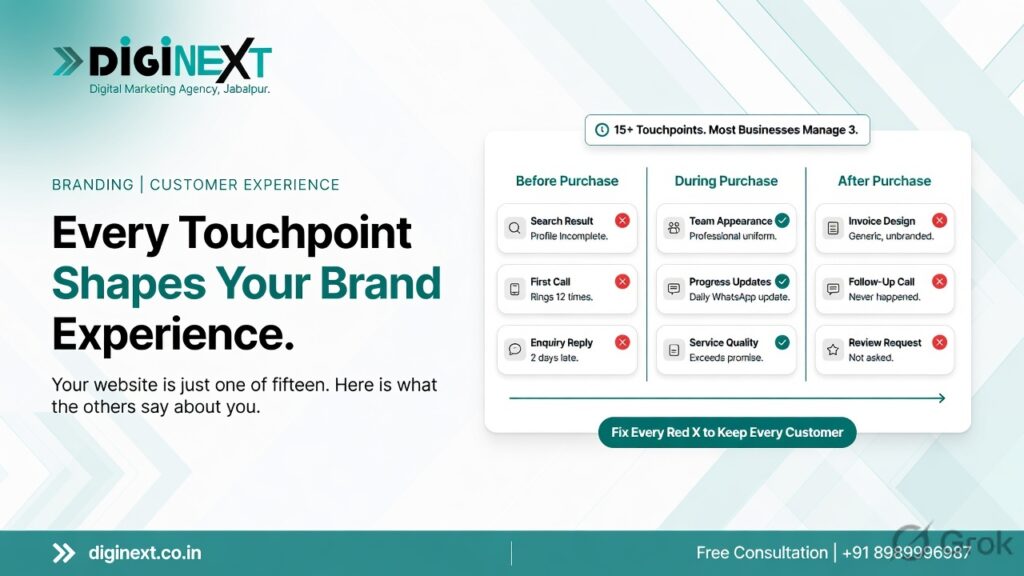
Before the purchase: the Google search result, the Google Business Profile listing, the first impression of the website, the social media profile, the review count and rating, the first phone call or WhatsApp message, the speed of response to an enquiry.
During the purchase: the professionalism of the proposal or quote, the clarity of pricing communication, the behaviour of the team during the service, the cleanliness and appearance of the space or vehicle, the communication during delivery or service.
After the purchase: the invoice or receipt, the follow-up message or call, whether anyone checked if the customer was satisfied; the packaging, if applicable; and whether the customer was ever asked for a review or referral.
That is at minimum fifteen to twenty touchpoints for a typical local business transaction. Most businesses invest seriously in two or three of them and leave the rest to chance.
The Pre-Purchase Touchpoints That Lose Customers Before They Contact You
The customer journey starts long before the first phone call. Most businesses do not realise how many customers they are losing before they ever speak to anyone.
The Google Business Profile is one of the most impactful pre-purchase touchpoints for any local business and one of the most consistently neglected. A profile with the default grey circle instead of a proper logo, no photos of the business or its work, outdated hours, and a handful of old reviews tells the customer this business does not take its online presence seriously. That impression transfers directly to expectations about how seriously the business will take the customer.
The first phone call or WhatsApp message is another touchpoint that either builds or destroys the impression created by the website. A website that looks professional and a phone that rings twelve times before anyone answers are sending contradictory signals. A business that responds to WhatsApp enquiries within minutes communicates that it values the customer. A business that takes two days to respond has told the customer something important about its priorities.
Response speed is particularly critical in Jabalpur’s competitive local market. Customers who are evaluating multiple options will often choose the first business that responds clearly and professionally. A slow, vague, or casual response to an initial enquiry loses customers to competitors who responded faster and more professionally, regardless of which business actually offers the better service.
The During-Purchase Touchpoints That Shape the Core Experience
The experience during the purchase or service delivery is where the brand promise either gets kept or broken. This is the touchpoint that generates reviews, referrals, and repeat purchases more than anything else.
The professionalism of the team during service delivery is a brand touchpoint. A uniformed team with clearly identified vehicles communicates a different brand than an unnamed person in casual clothes who parks randomly. Neither is inherently wrong for every business type, but the choice should be deliberate and consistent rather than accidental.
Communication during the service is a touchpoint most businesses completely ignore. A customer who books a renovation job and then hears nothing for three days wonders whether the job is on track. A business that sends a brief daily update, even a single WhatsApp message saying what was completed and what is next, creates a dramatically better brand experience from exactly the same quality of work.
The physical appearance of any space, vehicle, or equipment the customer encounters is a touchpoint. A spotlessly clean and organised service vehicle communicates professionalism even before the technician has spoken a word. A cluttered, branded-nowhere vehicle communicates the opposite. These details compound into the overall impression of whether this is a professional operation or an amateur one.
The Post-Purchase Touchpoints Most Businesses Completely Skip
Here is where most businesses leave significant brand equity and repeat business on the table. The transaction ends and the customer never hears from the business again.
The invoice or receipt is a brand touchpoint. A professionally designed invoice with the logo, the brand colours, clear line items, and a thank-you message at the bottom communicates something different from a handwritten chit or a generic digital bill with no brand identity. The customer pays based on the invoice. The last thing they see before the transaction completes is either reinforcing or undermining the brand impression.
A follow-up message two to three days after a purchase is a touchpoint that almost no small business in Jabalpur uses and yet has an outsized impact on customer loyalty and review generation. A simple WhatsApp message saying “Hope you are enjoying the furniture. Let us know if anything needs adjustment” does three things simultaneously. It demonstrates that the business cares beyond the sale. It creates an opening for the customer to raise any issues before they become complaints. And it puts the business back in the customer’s mind at exactly the moment they are most likely to leave a review or refer a friend.
The absence of follow-up is itself a brand experience touchpoint. A customer who buys from a business and never hears from it again has a transaction, not a relationship. Transactions generate one purchase. Relationships generate repeat purchases, referrals, and reviews.
Real Questions Business Owners Ask About Customer Touchpoints
1. How do I identify which touchpoints are most important to prioritise first?
Map every point where a customer contacts or experiences your business, from the first search result to the post-purchase follow-up. Then ask which touchpoints are currently creating the strongest negative impression. Start with those. A slow phone response that loses enquiries before they convert is more urgent to fix than perfecting the invoice design. A Google Business Profile with no photos is more urgent than redesigning the website. Fix the biggest leaks first, then optimise the rest.
2. Does brand experience differ by industry or is it the same for every business?
The specific touchpoints differ by business type but the principle is identical across all categories. A restaurant’s key touchpoints include the table setting, the menu design, the speed of service, and the way the bill is presented. A construction company’s key touchpoints include the appearance of the site, the clarity of progress updates, and the quality of the final walkthrough. The touchpoints are different but the principle is the same: every point of contact is communicating something about the business and should communicate the right thing.
3. My team handles most customer interactions. How do I ensure they represent the brand consistently?
Create a simple customer interaction guide that covers the most common scenarios: how to answer the phone, how to respond to WhatsApp enquiries, how to handle complaints, how to follow up after a job. Keep it practical and short, not a corporate manual. Run a brief session with the team explaining why consistency matters and what the specific standards are. Review a sample of customer interactions monthly and provide specific feedback. Consistency in team behaviour requires clear standards and regular reinforcement, not just a one-time briefing.
4. Is the digital brand experience more important than the physical one for local businesses?
Neither is more important in isolation. They work together to create the overall brand impression. A business with an excellent digital presence but a poor physical experience will lose customers after the first purchase, even if the digital impression was strong enough to win the first one. A business with an excellent physical experience but a weak digital presence will not attract enough new customers to sustain growth. The goal is consistency across both.
5. How do I measure whether my brand experience is improving?
Three metrics tell you the most. First, review score and review volume: customers who have a consistently good brand experience across all touchpoints leave more reviews and give higher ratings. Second, repeat purchase rate: customers who experience a genuinely consistent and professional brand come back more often. Third, referral rate: customers who feel their entire experience was handled professionally are more likely to recommend the business unprompted. Track these three metrics monthly and the direction of movement tells you whether the brand experience improvements are working.
Every Touchpoint is a Vote For or Against Your Brand
The brand experience a customer has is not made of the logo or the website or the Instagram feed. It is made of the sum of every interaction, every response, every piece of communication, every visual element, and every human behaviour they encounter from first search to last follow-up.
Businesses that win consistently in competitive local markets are the ones that have looked honestly at every touchpoint and invested in making each one consistent, professional, and deliberate. Not perfect. Not expensive. Just intentional.
Every touchpoint you leave to chance is a place where the brand impression you worked to create can be quietly undone. Fix them one at a time, starting with the ones that are currently doing the most damage, and the cumulative improvement in customer trust, reviews, and referrals will be more significant than any single marketing campaign could produce.