

Introduction
Your homepage is the most visited page on your website. It is the first impression most customers get of your business online. And for the majority of small businesses in Jabalpur, it is quietly losing more customers than every other problem on the site combined.
The frustrating part is that most business owners look at their homepage and think it is fine. It has a logo, a banner image, some text about the business, a list of services, and a contact form somewhere near the bottom. It looks like a proper website. What it is not doing is converting visitors into enquiries, because looking like a website and functioning as a homepage conversion tool are two completely different things.
Here is a specific breakdown of every reason your homepage is failing the people who land on it and exactly what needs to change.
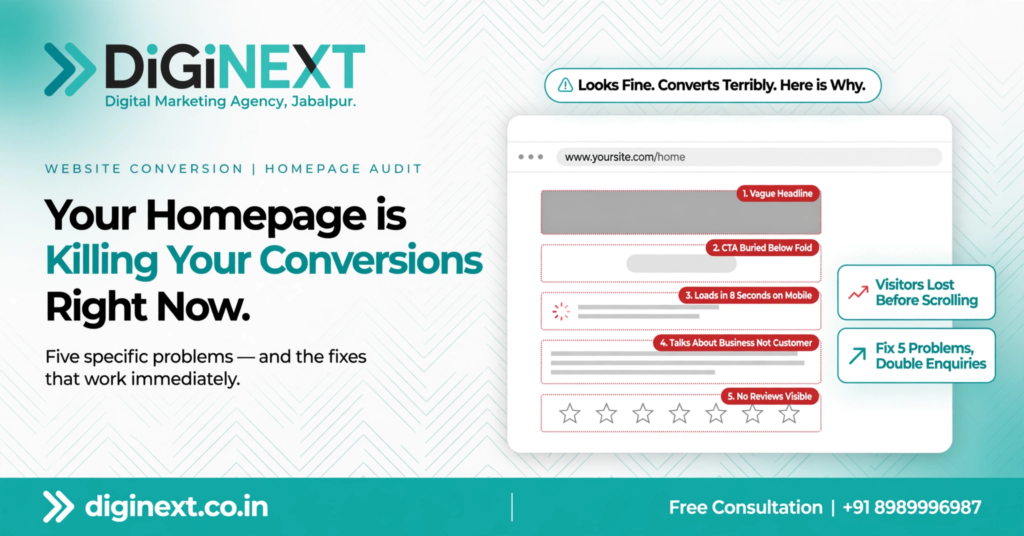
Problem 1: The Headline Above the Fold Tells Customers Nothing Useful
The most valuable piece of real estate on your entire website is the headline a visitor sees before they scroll. Whatever appears in that space, before the visitor has moved the page at all, determines whether they stay or leave. Most business owners waste it entirely.
Common homepage headlines that convert nobody: “Welcome to Our Website.” “Your Trusted Partner.” “Excellence in Everything We Do.” “Building Dreams Together.” These say nothing specific about what the business offers, who it serves, or why the visitor should stay. A visitor who lands on a homepage with one of these headlines learns nothing in the first three seconds and has no reason to scroll further.
A headline that converts tells the visitor three things immediately: what the business does, who it does it for, and what the visitor should do next. “Custom Furniture Made in Jabalpur. Delivered to Your Door in 18 Days. Call 8989996987 for a Free Design Consultation.” That headline answers every immediate question a local furniture buyer has before they have even scrolled an inch. The visitor knows instantly whether they are in the right place and what to do if they are.
The test for your current headline is simple. Show it to someone who has never heard of your business and ask them what the business does, who it serves, and what they should do next. If they cannot answer all three questions from the headline alone, the headline is failing its most important job.
Problem 2: The Call to Action is Buried, Vague, or Missing Entirely
A visitor who is interested in your business after reading the headline needs to know immediately what to do next. Most homepages make this harder than it should be.
The contact form buried at the bottom of a long homepage is the most common version of this problem. By the time a visitor has scrolled through the hero section, the about us paragraph, the list of services, the team photos, and the testimonials, they have either already decided to contact you or already left. Making them scroll to the very bottom to find a way to reach you loses a significant percentage of the ones who wanted to enquire but gave up before finding how.
The call to action on a homepage should appear at least three times: once prominently in the hero section before any scrolling, once somewhere in the middle of the page after the visitor has read enough to be interested, and once near the bottom for visitors who read everything. Each instance should be the same action, one clear step, not multiple competing options.
For most local businesses in Jabalpur, the single most effective call to action is a clickable phone number and a WhatsApp chat button that are always visible, even on mobile, as the visitor scrolls. A visitor who decides to contact you at any point on the page should be able to do so in one tap without searching for contact details. Every additional step between the decision to enquire and the ability to act loses a percentage of potential customers.
Problem 3: The Page Loads Too Slowly for Mobile Visitors
This is the homepage conversion killer that is most invisible to the business owner and most damaging to actual results. You open your homepage on your laptop at the office and it loads in two seconds. Your potential customer opens it on a mid-range Android phone on 4G in Jabalpur and waits eight seconds for it to load. They leave before the page finishes.
That customer shows up in your analytics as a visitor. They had zero experience of your homepage content. The conversion had no chance because the page never loaded properly before they left.
Google’s own data shows that as page load time goes from one second to three seconds, the probability of a mobile visitor bouncing increases by 32 percent. From one second to five seconds, that probability increases by 90 percent. These are not abstract statistics. They translate directly into the number of potential customers who never see your homepage content because they left while it was still loading.
Check your homepage on Google PageSpeed Insights right now and look specifically at the mobile score. A score below 50 is a serious problem. A score below 30 means the majority of your mobile visitors are leaving before the page fully loads. The most common causes are uncompressed images, too many plugins, and budget hosting that cannot serve pages fast enough. All three are fixable without rebuilding the website.
Problem 4: The Homepage Talks About the Business Instead of the Customer
This is the most pervasive and most damaging problem on small business homepages in Jabalpur, and it is rooted in a completely understandable instinct. The business owner worked hard to build the company, knows everything about it, and wants to share that story. The result is a homepage full of information about the business: its history, its values, its awards, its team, its process.
None of this is what a first-time visitor wants to know. They arrived with a specific need or problem. They want to know within the first few seconds whether this business can solve that problem. They do not want to read about the company’s founding story or its commitment to quality before they know whether it offers what they came looking for.
The homepage that converts leads with the customer’s problem or need, not the business’s story. “Struggling to rank on Google?” is a more powerful opening for a digital marketing homepage than “We are a team of passionate marketers.” “Looking for a coaching centre that gives your child individual attention?” is more powerful than “We have been teaching students since 2018.” The story can come later, after the visitor has confirmed they are in the right place. Leading with it is placing the business’s interests ahead of the visitor’s needs, and visitors leave when they feel that.
Problem 5: The Page Has No Social Proof Above the Scroll Line
A new visitor to your homepage has a fundamental question that everything else on the page is trying to answer: can I trust this business? The most powerful trust signal available to any business is social proof, and most homepages either have none or have it buried so far down the page that visitors never reach it.
A homepage that shows a row of five-star Google review snippets with customer names and specific feedback immediately below the hero section is doing something that all the business descriptions and quality claims in the world cannot do: it is letting other customers do the convincing. A visitor who sees “We have 140 Google reviews” or reads three specific testimonials from local customers within the first scroll has a fundamentally different trust level than one who sees a generic “Why Choose Us” section with bullet points.
The social proof that works hardest on a homepage is specific and local. Not “clients love us” but “Here is what Ramesh from Jabalpur said after his renovation.” Not a star icon but an actual review count that a visitor can verify on Google. Not a vague testimonial but a specific outcome: “They delivered our furniture in exactly 17 days as promised and it fits perfectly.” That kind of specific, verifiable social proof placed prominently on the homepage converts visitors into enquiries at a dramatically higher rate than any design element or feature list.
Real Questions Business Owners Ask About Homepage Conversion
1. How do I know which part of my homepage is causing visitors to leave?
Google Analytics shows you the average time on page and the scroll depth for your homepage. Scroll depth data tells you exactly how far down the page most visitors get before leaving. If 60 percent of visitors leave before reaching the middle of the page, everything in the bottom half is invisible to most of your audience. Hotjar and Microsoft Clarity are free tools that provide visual heatmaps showing exactly where visitors click, how far they scroll, and where they abandon. These tools make the invisible visible and tell you specifically which homepage problem to fix first.
2. How long should a homepage actually be?
Long enough to answer every question a motivated visitor would have, and not a word longer. For most local service businesses, this means a clear hero section with headline and call to action, a brief explanation of what makes the business different, three to five key services described concisely, a prominent social proof section with reviews or testimonials, and a final call to action. This typically produces a homepage between 600 and 900 words of visible content. Longer is not better if the additional content is vague or repetitive. Shorter is not better if it leaves important questions unanswered.
3. Should my homepage be the landing page for my Google Ads?
Almost never. A homepage is built to serve multiple types of visitors with different needs and different stages of the buying journey. A Google Ad is built for one specific search query from one specific type of customer with one specific intent. Sending that customer to a homepage gives them too many options and too little specific relevance to what they searched for. A dedicated landing page built specifically for the ad’s message and the searcher’s intent will convert at two to five times the rate of a homepage for the same traffic. The investment in building dedicated landing pages for paid campaigns is almost always worth it.
4. Do I need a professional to fix my homepage or can I do it myself?
Many homepage problems can be fixed without a developer. Rewriting the headline, adding a clickable phone number to the top of the page, moving testimonials higher, and compressing images are all changes most business owners can make in a website builder or WordPress without technical help. For speed improvements related to hosting, caching, or code, a developer is typically needed. Start with the content and structural changes you can make yourself, measure the impact on enquiry volume over four weeks, and then bring in a professional for the technical improvements if the budget allows.
5. My homepage has a lot of information because I want customers to know everything about us. Is that wrong?
Comprehensive information is not wrong. The sequence and emphasis are what matter. A visitor needs to answer their most urgent question first: is this business relevant to what I need? Only after that is confirmed will they want to know more. Structure the homepage so that relevance is established immediately in the hero section, key details follow in a logical order, and deeper information is available further down the page for visitors who want it. Information overload in the first screen is what kills conversions, not information overload in the page overall.
The Homepage That Converts Does One Job Exceptionally Well
Every element on a converting homepage serves the same purpose: moving the visitor from “I found this business” to “I am going to contact them.” A clear headline that immediately establishes relevance. A prominent call to action that appears before the visitor has to scroll. A page that loads fast enough on mobile that the visitor actually sees it. Content that speaks to the customer’s need rather than the business’s story. Social proof placed where visitors will actually see it.
None of these are design improvements. They are strategic improvements to how the page communicates with the specific person standing at the digital equivalent of your front door for the first time. Fix the strategy and the homepage conversion rate improves regardless of how the page looks.